9 AI Recruiting Tools That Replace Manual Hiring Workflows
Hiring still relies heavily on repetitive tasks like sourcing candidates, screening resumes, and coordinating interviews, which slows down your entire process and drains valuable time.
When every step depends on manual effort, it becomes harder to scale, respond quickly, or secure top talent before competitors do.
This is where AI recruiting tools change the game by automating these workflows end-to-end.
Instead of managing each step manually, you can streamline hiring, move faster, and reduce effort across the entire recruitment process.
Why Manual Hiring Workflows Are Slowing You Down
If you’ve ever felt like hiring takes longer than it should, you’re not wrong.
Most of the delay doesn’t come from decision-making, it comes from the way the process is structured.
Traditional hiring workflows are filled with repetitive, manual steps that slow you down at every stage.
From finding candidates to scheduling interviews, each task depends on human effort, making the entire process harder to scale and optimize.
As hiring needs grow, these inefficiencies become more visible, pushing you to look for faster and more reliable ways to manage the process.
Time Lost in Manual Candidate Sourcing
The hiring process usually starts with sourcing, and this is where the first major delay happens.
You often switch between multiple platforms like LinkedIn, job boards, and internal databases just to find relevant candidates.
Each search requires filters, keywords, and constant tweaking, which takes hours before you even build a decent pipeline.
On top of that, your reach is limited to the platforms you actively search, which means you miss out on potential candidates who are not immediately visible.
By the time you shortlist a few profiles, you’ve already spent significant time on a task that could have been automated.
Screening and Shortlisting Takes Too Long
Once you have a pool of candidates, the next challenge is reviewing and shortlisting them.
Manually going through resumes is repetitive, and it becomes harder as the number of applicants increases.
You end up scanning similar profiles, comparing skills, and trying to assess fit without a consistent system.
This not only slows down decision-making but also increases the chances of overlooking strong candidates.
Delays at this stage can cost you top talent, especially when faster-moving companies are already reaching out.
Coordination and Scheduling Chaos
After shortlisting, coordination becomes another bottleneck that’s often underestimated.
You send emails back and forth to find a suitable time, wait for responses, and manage calendar conflicts.
Even a simple interview can take days to schedule because of availability mismatches.
This constant back-and-forth creates friction, both for you and the candidate.
Over time, it leads to a poor candidate experience and unnecessary delays in closing roles.
Suggested Reading:
AI Recruiters vs Human RecruitersFactors We Choose to Prepare This List
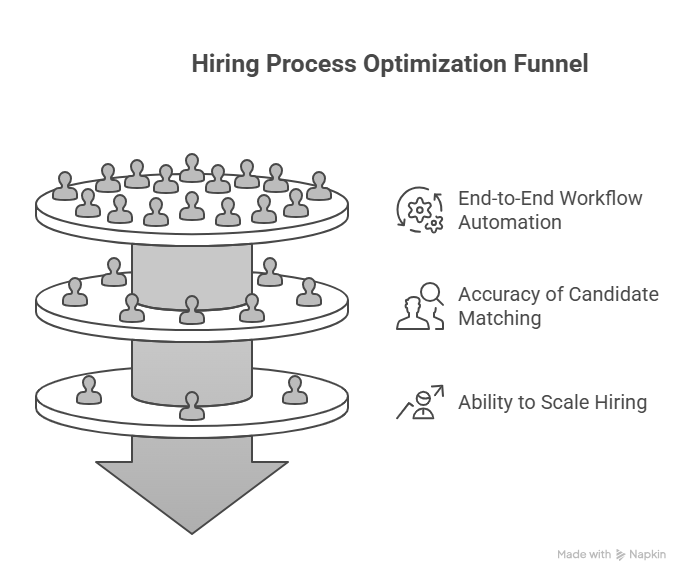
Not every tool solves the full problem, so we focused on options that reduce manual effort, improve decision-making, and help you scale hiring without adding complexity.
End-to-End Workflow Automation
One of the biggest factors we considered is how much of the hiring workflow a tool can automate.
Instead of solving just one step, the focus is on tools that connect sourcing, screening, outreach, and scheduling into a single flow.
This reduces the need to switch between multiple platforms and eliminates gaps between stages.
When everything works together, you spend less time managing tasks and more time making hiring decisions.
Accuracy of Candidate Matching
Automation only works if the results are relevant.
That’s why we looked at how accurately each tool matches candidates to job requirements.
Strong matching reduces the need to manually review every profile and helps you focus only on the most relevant candidates.
This not only saves time but also improves the quality of your shortlist, making hiring decisions faster and more reliable.
Ability to Scale Hiring Efficiently
As your hiring needs grow, your process should not become more complicated.
We prioritized tools that allow you to handle more roles and candidates without increasing your workload.
By using automation to manage repetitive tasks, these tools help maintain speed and consistency even at scale.
This ensures you can grow your hiring efforts without sacrificing efficiency or candidate experience.
9 AI Recruiting Tools That Replace Manual Hiring Workflows
Now that you know what slows hiring down, let’s look at tools that fix it.
Each one replaces manual tasks like sourcing, screening, and scheduling, so you can find the right fit faster.
1. Leelu AI – End-to-End AI Recruiting Tool with Flexible Pricing
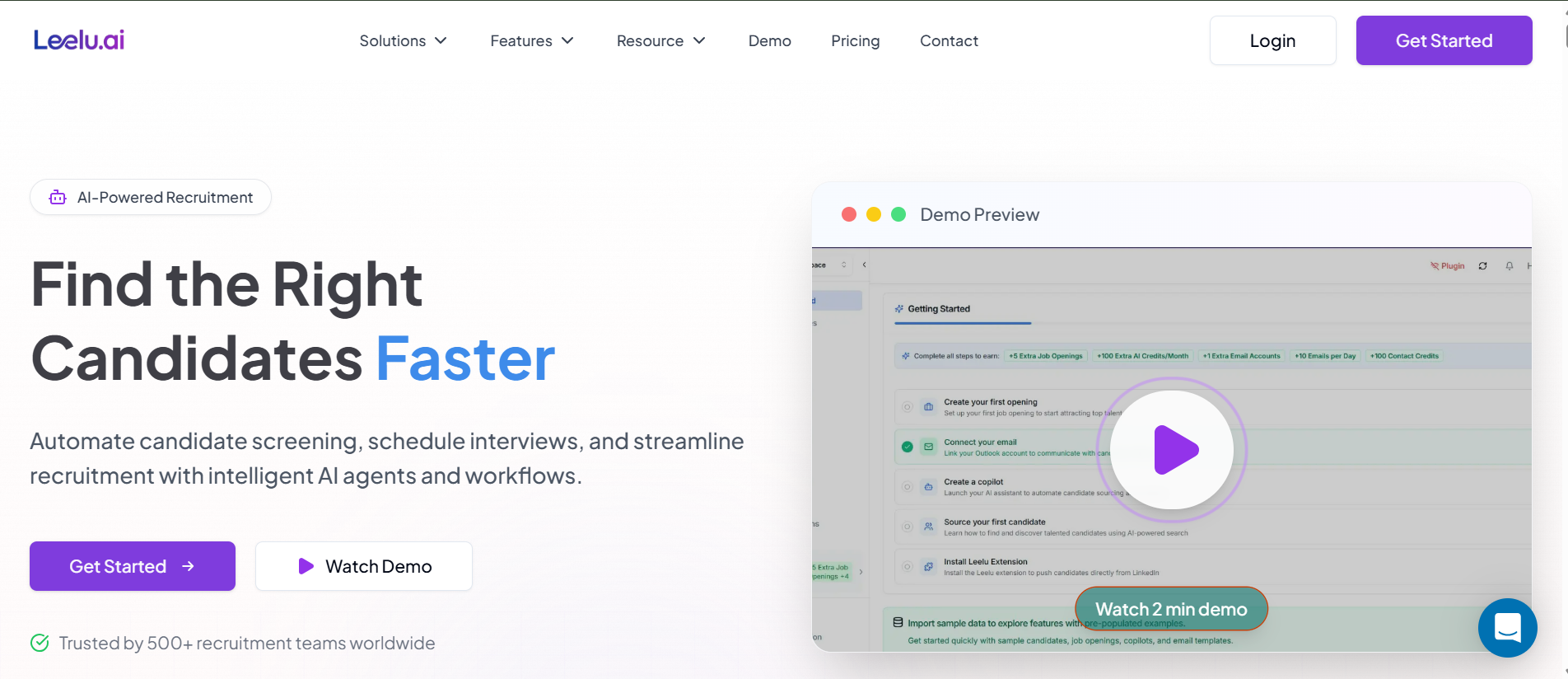
If you’re still using separate tools for sourcing, screening, and scheduling, your hiring process is likely slower than it should be.
Instead of fixing one step at a time, Leelu replaces the entire workflow with AI-driven automation.
From finding candidates to booking interviews, everything runs in one connected system, helping you move from job post to first interview in around 24 hours while significantly reducing manual effort.
Pricing of Leelu AI (Flexible + Usage-Based Model)
- Starts from $79/month for small teams with basic AI features
- Growth plans range between $149–$499/month for advanced automation and integrations
- Enterprise pricing is custom, starting around $600+ per month, based on your hiring scale
- Comes with a 14-day free trial, so you can explore full features before committing
What Makes Leelu Different
Most AI recruiting tools handle only one part of hiring, leaving the rest manual.
Leelu replaces the entire workflow by automating sourcing, screening, outreach, and scheduling in one unified platform.
Key Features of This AI Recruiting Tool
Leelu automates every major step of hiring within one system.
- Access 500M+ candidate profiles across LinkedIn, job boards, and ATS
- Screen and rank 1000+ resumes in minutes using AI scoring
- Send 100–300 personalized outreach messages daily across email and LinkedIn
- Automate 24/7 follow-ups with AI-driven responses
- Schedule interviews in under a minute with calendar sync
- Integrate with 10+ platforms including ATS systems
This setup ensures your hiring workflow runs continuously without manual intervention.
What Manual Hiring Tasks It Replaces
Leelu removes the most time-consuming and repetitive parts of recruiting.
- Manual candidate sourcing across platforms
- Resume screening and shortlisting
- Writing and sending outreach messages individually
- Following up with candidates manually
- Coordinating interview schedules through back-and-forth emails
By automating these tasks, it turns hiring into a faster and more structured process.
Benefits of Using Leelu AI for Hiring Workflows
The impact is clear when you look at speed, effort, and scale.
- Reduce hiring effort by 70–85% with end-to-end automation
- Move from job post to first interview in around 24 hours
- Improve response rates by 40–60% with personalized outreach
- Scale hiring without increasing team size or adding more tools
- Manage the entire hiring pipeline in one platform
This allows you to hire faster without compromising on quality.
Pros and Cons of Using Leelu AI
Every tool has its trade-offs, depending on how you hire.
Pros:
- End-to-end automated hiring workflow
- Reduces manual effort significantly
- Strong candidate matching and outreach
- Replaces multiple recruiting tools
Cons:
- Takes time to set up workflows initially
- Advanced features may feel overwhelming at first
- Needs optimization to get full value
If you want to fully replace manual hiring workflows, Leelu works as a complete solution.
2. HireVue – AI Interviewing and Screening Tool
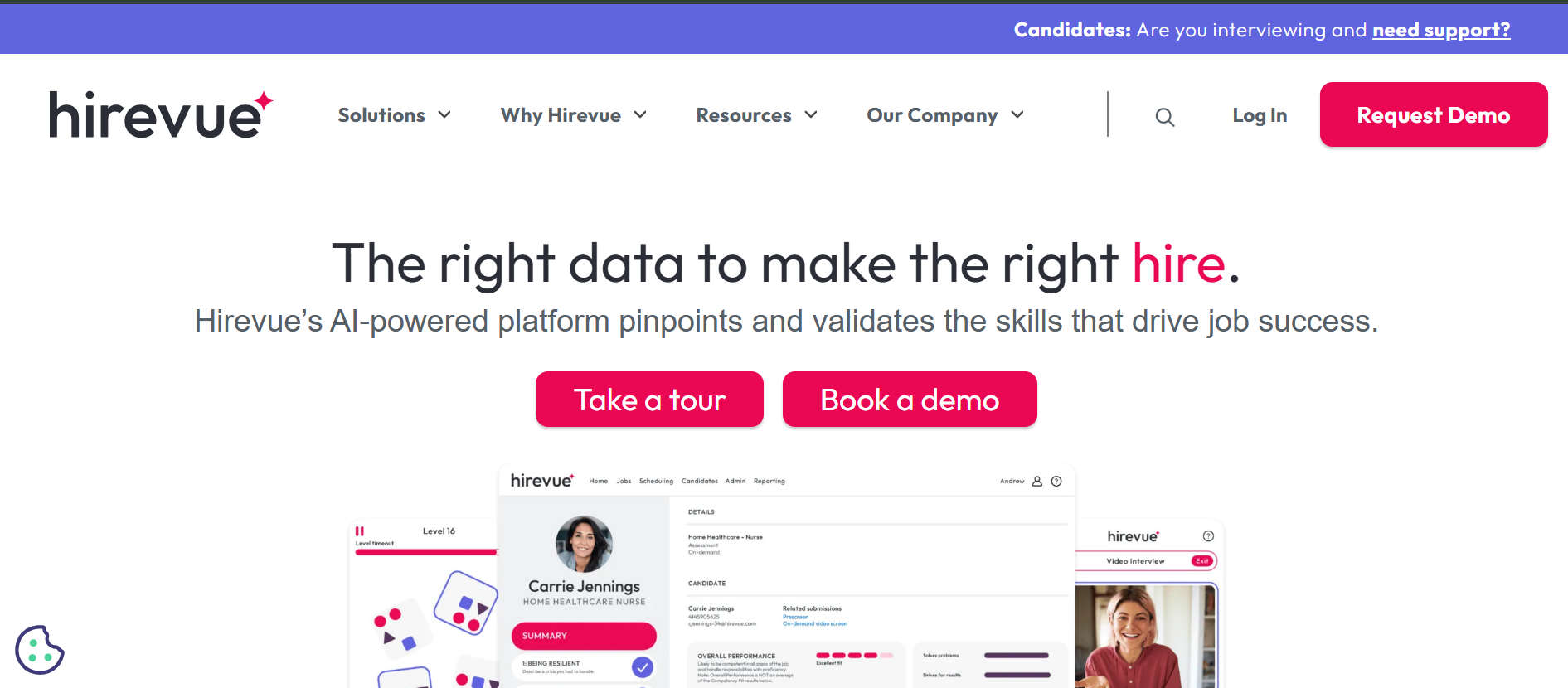
If your early-stage screening still depends on calls and manual evaluation, it can quickly become a bottleneck.
HireVue helps automate this stage by using video interviews combined with AI analysis to assess candidates faster.
Instead of scheduling multiple screening calls, you can evaluate candidates asynchronously while maintaining consistency in how each profile is reviewed.
What It Replaces
HireVue removes the need for repetitive initial screening calls and manual candidate assessments.
You no longer have to spend hours coordinating and conducting the same first-round interviews for every candidate.
Key Features and Benefits
- On-demand video interviews for flexible candidate evaluation
- AI-driven analysis to assess responses consistently
- Structured evaluation to reduce bias and improve decision-making
This helps you screen candidates faster while maintaining a standardized process.
Pros and Cons
Pros:
- Saves time on initial screening
- Ensures consistent evaluation across candidates
- Reduces scheduling dependency
Cons:
- Limited to early-stage screening
- AI evaluation may lack human context in some cases
It works best if your goal is to streamline and standardize the first stage of hiring.
3. Pymetrics – AI-Based Candidate Assessment Platform
If you rely heavily on resumes to evaluate candidates, you might be missing deeper insights.
Pymetrics replaces traditional screening with behavioral and cognitive assessments, helping you understand how candidates think and perform.
Instead of judging profiles only on experience, it uses data-driven insights to improve the quality of your hiring decisions.
What It Replaces
Pymetrics removes the need for manual resume screening and subjective evaluation.
You no longer have to rely only on what’s written on a resume to assess candidate fit.
Key Features and Benefits
- Behavioral games to assess cognitive and emotional traits
- AI-driven matching based on role requirements
- Data-backed insights to improve hiring accuracy
This helps you identify candidates who are a better fit beyond just qualifications.
Pros and Cons
Pros:
- Goes beyond resume-based screening
- Reduces bias in early-stage evaluation
- Improves quality of candidate matching
Cons:
- May not suit roles needing strict experience-based screening
- Requires candidates to complete assessments
It works well if you want to make more objective and data-driven hiring decisions.
4. Fetcher – AI Candidate Sourcing Tool
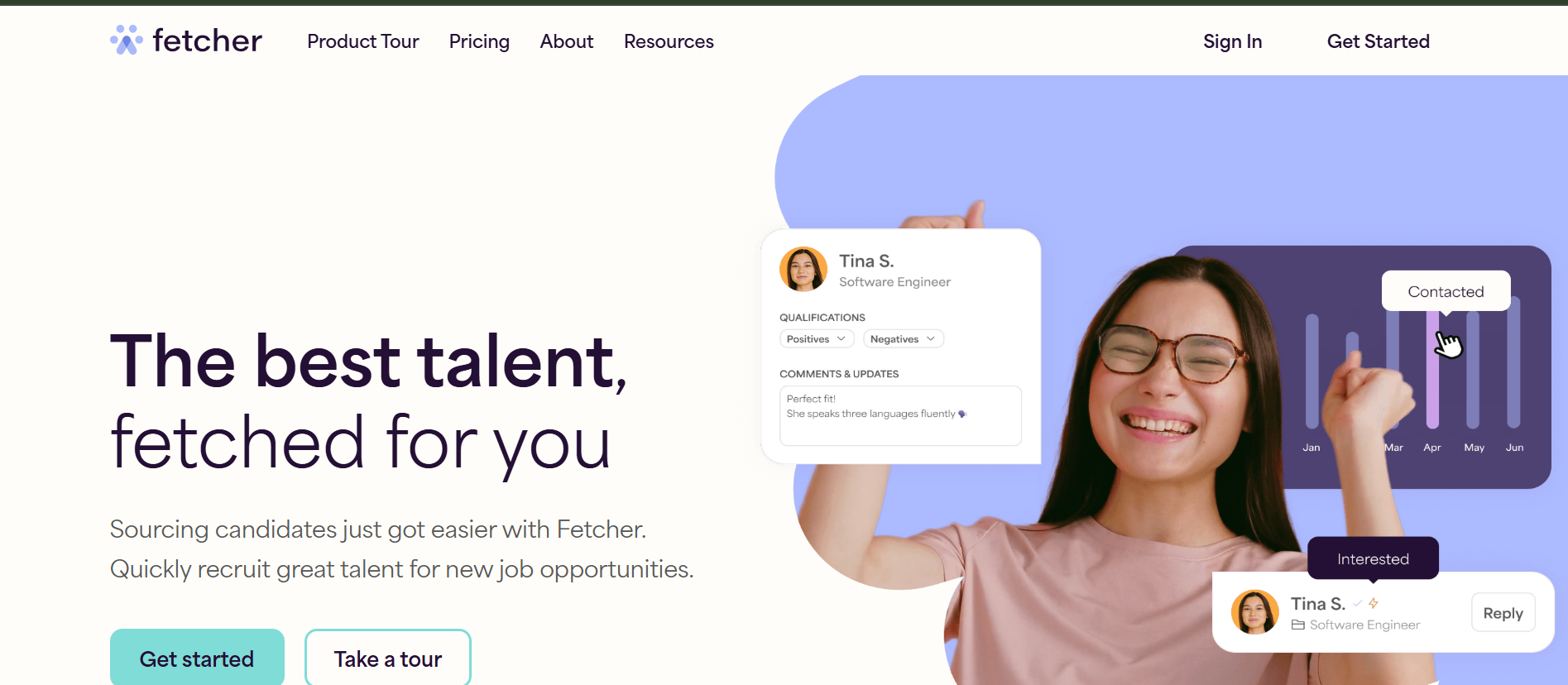
Sourcing candidates manually across platforms can take hours before you even start outreach.
Fetcher simplifies this by automating both candidate sourcing and initial engagement, helping you build a pipeline faster.
Instead of searching and reaching out separately, it combines both steps into one streamlined workflow.
What It Replaces
Fetcher replaces manual candidate sourcing across platforms.
You no longer need to spend hours searching, filtering, and switching between tools to find relevant profiles.
Key Features and Benefits
- Automated candidate sourcing based on job requirements
- Built-in outreach workflows to engage candidates
- Continuous pipeline building without manual effort
This helps you move faster from sourcing to engagement without delays.
Pros and Cons
Pros:
- Saves time on sourcing and outreach
- Builds candidate pipelines consistently
- Reduces manual search effort
Cons:
- Limited to sourcing and outreach stages
- Less control compared to manual sourcing in niche roles
It works best if you want to speed up candidate discovery and initial engagement.
5. SeekOut – AI Talent Intelligence Platform
Finding qualified candidates often means running complex searches across multiple filters and platforms.
SeekOut simplifies this by using advanced search capabilities and talent insights to help you discover highly relevant candidates faster.
It gives you deeper visibility into talent pools, making sourcing more strategic and less manual.
What It Replaces
SeekOut replaces complex manual searches and filtering.
You no longer need to rely on trial-and-error keyword searches to find the right candidates.
Key Features and Benefits
- Advanced search with detailed filtering options
- Talent insights and analytics for better decision-making
- Access to diverse and specialized talent pools
This helps you identify high-quality candidates with more precision.
Pros and Cons
Pros:
- Strong search and filtering capabilities
- Access to niche and diverse talent pools
- Data-driven sourcing insights
Cons:
- Focused mainly on sourcing
- Can require learning to use advanced filters effectively
It works best if you want more control and depth in candidate discovery.
6. Eightfold AI – Talent Matching Platform
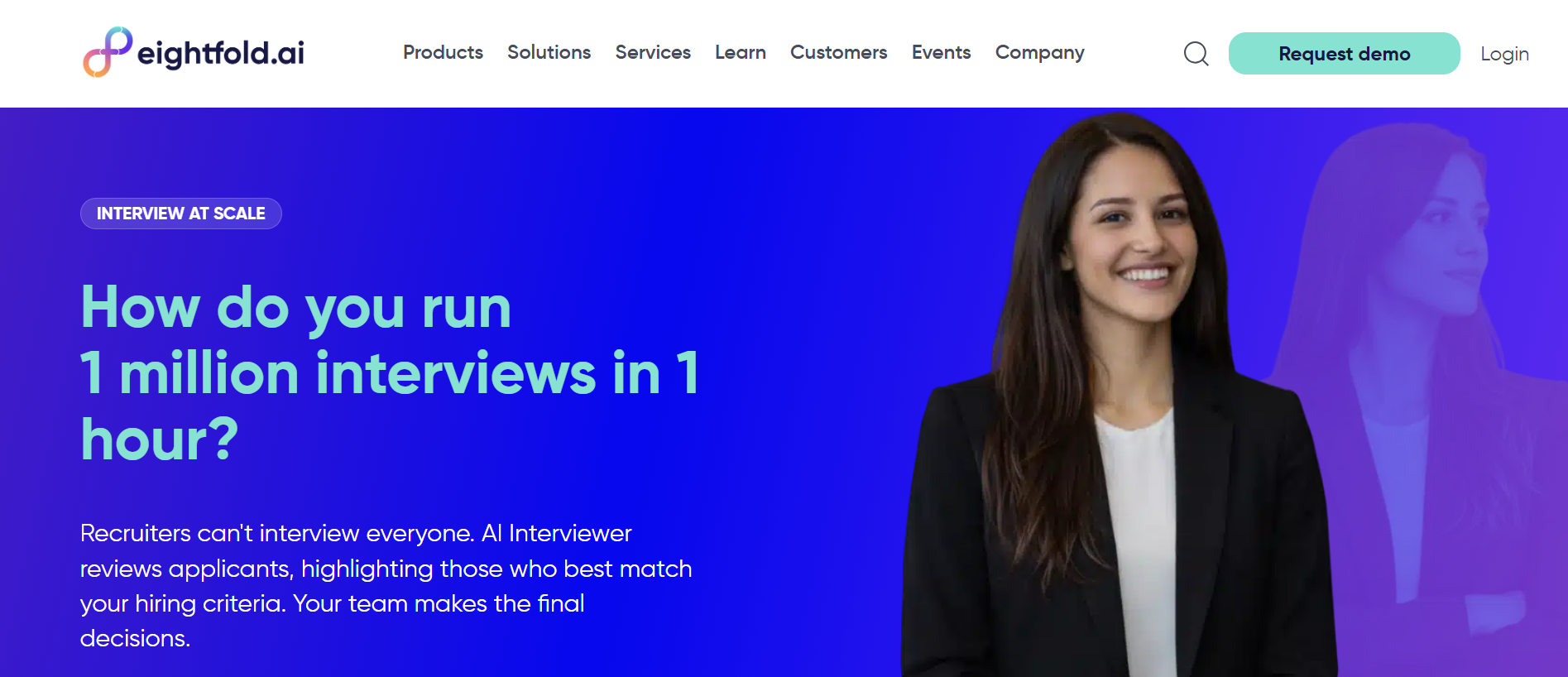
Matching candidates manually to roles often leads to missed opportunities and inefficiencies.
Eightfold AI uses deep learning to match candidates to roles based on skills, experience, and potential.
It also helps rediscover candidates from your existing database, improving overall hiring efficiency.
What It Replaces
Eightfold replaces manual candidate matching and rediscovery.
You no longer need to manually revisit old profiles or rely only on current applicants.
Key Features and Benefits
- AI-driven talent matching using deep learning
- Candidate rediscovery from existing databases
- Continuous learning from hiring data
This helps improve match accuracy and reduce missed opportunities.
Pros and Cons
Pros:
- Strong matching accuracy
- Helps reuse existing talent data
- Improves hiring efficiency over time
Cons:
- Requires data for optimal performance
- More focused on matching than full workflow automation
It works well if your focus is improving candidate-role fit at scale.
Suggested Reading:
What is Full Desk Recruiting?7. XOR – AI Recruiting Chatbot
Managing candidate communication manually can slow down your hiring process.
XOR automates candidate engagement using AI chatbots, helping you respond instantly and maintain consistent communication.
It keeps candidates engaged without requiring constant manual follow-ups.
What It Replaces
XOR replaces manual communication and follow-ups.
You no longer need to send repetitive messages or track candidate responses manually.
Key Features and Benefits
- AI chatbot for real-time candidate interaction
- Automated follow-ups and engagement workflows
- Multi-channel communication support
This ensures candidates stay engaged throughout the process.
Pros and Cons
Pros:
- Improves response speed and engagement
- Reduces manual communication effort
- Works across multiple communication channels
Cons:
- Limited to communication and engagement
- May require customization for tone and workflows
It works best if you want to automate candidate communication at scale.
8. Paradox (Olivia) – Conversational AI Recruiting Tool
Scheduling and repetitive interactions can create unnecessary delays in hiring.
Paradox, through its conversational AI assistant Olivia, automates these interactions, making hiring faster and more responsive.
It interacts with candidates in real time, reducing dependency on manual coordination.
What It Replaces
Paradox replaces scheduling coordination and repetitive candidate interactions.
You no longer need to manage back-and-forth emails for interview setup.
Key Features and Benefits
- Conversational AI for real-time candidate engagement
- Automated interview scheduling and coordination
- Integration with calendars and hiring systems
This helps streamline communication and scheduling without delays.
Pros and Cons
Pros:
- Speeds up scheduling and communication
- Improves candidate experience
- Reduces coordination effort
Cons:
- Focused mainly on engagement and scheduling
- Less coverage of sourcing or screening stages
It works well if you want to remove friction from candidate interactions.
9. HireEZ – AI Sourcing and CRM Platform
Managing sourcing and candidate pipelines separately can make hiring fragmented.
HireEZ combines AI sourcing with CRM capabilities, helping you manage candidates from discovery to engagement in one place.
This makes your hiring workflow more organized and easier to scale.
What It Replaces
HireEZ replaces manual sourcing and fragmented candidate tracking.
You no longer need separate tools to find candidates and manage pipelines.
Key Features and Benefits
- AI-powered sourcing across multiple platforms
- Built-in CRM for pipeline management
- Outreach and engagement tools in one system
This helps you manage sourcing and relationships more efficiently.
Pros and Cons
Pros:
- Combines sourcing and CRM in one platform
- Improves pipeline visibility
- Reduces need for multiple tools
Cons:
- May require setup for full workflow alignment
- Not fully end-to-end like complete automation platforms
It works best if you want better control over sourcing and candidate pipelines.
How to Choose the Right AI Recruiting Tool for Your Workflow
Now that you’ve seen different AI recruiting tools, the right choice depends on your hiring challenges.
Focus on where you’re losing time and choose a tool that removes bottlenecks without adding complexity.
Identify Your Biggest Hiring Bottleneck
Start by identifying where your hiring process slows down the most.
It could be sourcing candidates, screening resumes, or coordinating interviews.
When you know your biggest bottleneck, it becomes easier to choose a tool that directly solves that problem instead of adding unnecessary features.
End-to-End vs Point Solutions
Some tools automate the entire hiring workflow, while others focus on just one stage.
End-to-end tools help you manage everything in one place, while point solutions solve specific problems like sourcing or screening.
Choosing between them depends on whether you want a complete system or just need to fix one part of your process.
Ease of Use and Integration
A tool is only useful if it fits into your existing workflow.
Look for platforms that are easy to use and integrate with your current systems like ATS or calendars.
This ensures smooth adoption and helps you get value from the tool without disrupting your hiring process.
Conclusion
Hiring no longer needs to depend on slow, manual workflows that limit your speed and efficiency.
AI recruiting tools are changing how hiring works by automating sourcing, screening, outreach, and scheduling in a more structured and scalable way.
Instead of managing disconnected tasks, you can build a streamlined process that moves faster and delivers better results.
The key is to choose the right tool based on your hiring challenges and workflow gaps, so you can reduce effort, improve outcomes, and scale hiring with confidence.
Frequently Asked Questions
1. What are AI recruiting tools?
AI recruiting tools are software platforms that automate tasks like sourcing, screening, outreach, and scheduling, helping you reduce manual effort and speed up the hiring process.
2. How do AI recruiting tools replace manual hiring workflows?
They automate repetitive steps such as searching for candidates, reviewing resumes, sending messages, and scheduling interviews, turning a manual process into a streamlined workflow.
3. Are AI recruiting tools suitable for small teams?
Yes, many tools offer flexible pricing and automation features that help small teams handle hiring efficiently without needing to expand their recruiting team.
4. Do AI recruiting tools improve candidate quality?
Most tools use AI matching and data-driven insights to shortlist more relevant candidates, which can improve the overall quality of hires.
5. How do I choose the right AI recruiting tool?
Start by identifying your biggest hiring bottleneck, then choose a tool that solves that problem while fitting into your workflow and scaling with your hiring needs.