How AI Improves Candidate Matching in Recruiting
Hiring the right candidate sounds simple until you actually start recruiting.
You post a job, receive hundreds of resumes, manually screen profiles, shortlist candidates, and still end up interviewing people who are not the right fit.
The biggest challenge is not finding candidates anymore.
It is finding the right candidates quickly.
This is exactly where AI candidate matching in recruiting is changing how companies hire.
Instead of relying only on keyword filters or manual resume reviews, AI can analyze skills, experience, intent, job fit, and behavioral signals to identify better matches faster.
In this guide, you’ll learn:
- How AI improves candidate matching in recruiting
- Why traditional matching methods fail
- How AI recruitment matching algorithms work
- Key benefits of AI-powered candidate screening
- Common challenges and limitations
- How recruiting teams use AI to hire faster and smarter
Why Traditional Candidate Matching Often Fails
Most traditional recruiting workflows still depend heavily on manual effort.
Recruiters search profiles using keywords, review resumes individually, and compare candidates against job descriptions one by one.
The problem is that resumes rarely tell the full story.
A strong candidate may use different terminology than the recruiter expects.
Another candidate may appear qualified on paper but lack actual role fit.
This creates several hiring problems:
- Good candidates get overlooked
- Recruiters spend hours screening resumes manually
- Hiring cycles become slower
- Shortlists become inconsistent
- Bias can influence decision-making
This is why companies are increasingly exploring how AI improves candidate matching in recruitment workflows.
AI helps recruiters move beyond surface-level keyword matching and evaluate candidates more intelligently.
How AI Improves Candidate Matching in Recruiting
AI candidate matching in recruiting goes far beyond simple keyword filtering.
Instead of only checking whether a resume contains exact terms from a job description, AI analyzes multiple data points together to understand actual job fit.
These systems evaluate factors like:
- Skills and competencies
- Work experience
- Industry background
- Career progression
- Candidate behavior
- Hiring success patterns from previous hires
This helps recruiters identify stronger candidates faster while reducing manual screening work.
Suggested Reading:
How to Source Candidates from Job Portals: Step-by-Step Guide1. AI Understands Skills Beyond Keywords
Traditional ATS systems often reject good candidates because the resume wording does not exactly match the job description.
AI-powered recruiting systems use Natural Language Processing (NLP) to understand related skills and context.
Example:
A recruiter searches for a “Business Development Manager” with SaaS sales experience.
One candidate writes:
- “Client acquisition”
- “Revenue growth”
- “Enterprise software sales”
Another writes:
- “Business development”
- “Lead generation”
- “SaaS pipeline management”
A traditional ATS may only prioritize the second profile because it matches exact keywords.
AI understands that both candidates have highly relevant experience even though the wording differs.
This helps recruiters uncover qualified candidates they may otherwise miss.
2. AI Ranks Candidates Based on Actual Job Fit
One major advantage of AI candidate matching in recruitment is automated candidate scoring.
Instead of manually screening hundreds of resumes, AI compares candidate profiles against job requirements and ranks them based on overall fit.
The scoring usually considers:
- Skill alignment
- Relevant experience
- Seniority level
- Industry expertise
- Certifications
- Location preferences
Example:
A healthcare company hiring a Data Analyst may value healthcare domain experience more than general analytics experience.
Even if Candidate A has stronger technical keywords, AI may rank Candidate B higher because they previously worked with healthcare data and insurance analytics.
This creates more accurate shortlists instead of purely keyword-based results.
3. AI Learns From Past Hiring Patterns
Modern AI recruiting systems improve over time by learning from hiring outcomes.
They analyze patterns like:
- Which candidates get shortlisted
- Which candidates get hired
- Interview feedback
- Offer acceptance rates
- Employee performance data
Example:
Suppose a company notices that candidates from startup environments consistently perform better in fast-paced roles than candidates from large enterprises.
AI can detect this pattern and begin prioritizing similar profiles for future openings.
Over time, the system becomes better at identifying candidates who are more likely to succeed in a specific company or role.
4. AI Identifies Transferable Skills
AI also helps recruiters discover candidates with adjacent or transferable skills.
This is especially useful when ideal candidates are hard to find.
Example:
A company hiring cybersecurity analysts may struggle to find applicants with direct cybersecurity experience.
AI may still surface candidates from:
- Network engineering
- Cloud infrastructure
- IT operations
because their technical foundations strongly overlap with cybersecurity requirements.
Traditional systems often miss these candidates entirely.
5. AI Reduces Manual Screening Time
Recruiters often receive hundreds or thousands of applications for a single role.
AI helps automate repetitive screening tasks by:
- Parsing resumes
- Extracting candidate data
- Matching profiles to job requirements
- Ranking candidates automatically
Example:
A startup hiring for 15 sales roles receives 4,000 applications.
Instead of manually reviewing every resume, recruiters can instantly focus on the top-ranked candidates identified by AI.
This significantly reduces time-to-hire while improving recruiter productivity.
Benefits of AI Candidate Matching in Recruiting
Once companies understand how AI improves candidate matching in recruiting, the next question usually becomes whether the results are actually measurable.
In most cases, the answer is yes.
AI-driven recruiting significantly improves hiring efficiency and candidate quality.
1. Faster Candidate Screening
AI can screen thousands of resumes within minutes.
This dramatically reduces the time recruiters spend on repetitive manual review tasks.
Instead of spending days building a shortlist, recruiters can identify strong matches almost instantly.
2. Better Quality Shortlists
Because AI analyzes multiple data points together, shortlists become more relevant and accurate.
Recruiters spend less time interviewing unqualified candidates.
This improves overall hiring quality and reduces bad hires.
3. Reduced Hiring Bias
AI can help reduce unconscious bias when designed properly.
Instead of relying on subjective judgments, AI focuses on skills, qualifications, and job-fit indicators.
This creates a more structured and consistent evaluation process.
However, AI still requires human oversight to ensure fairness and transparency.
4. Improved Candidate Experience
Faster matching also improves the candidate experience.
Qualified candidates receive quicker responses, faster interview scheduling, and more relevant opportunities.
This becomes especially important in competitive hiring markets where delays can lead to losing top talent.
How AI Matching Algorithms Work in Recruitment
When people ask “how does AI improve candidate matching in recruiting,” they often imagine simple automation.
In reality, AI recruiting systems use multiple technologies together.
These usually include:
1. Natural Language Processing (NLP)
NLP helps AI understand resume content, job descriptions, and candidate communication more intelligently.
It identifies meaning and relationships between terms instead of relying only on exact keyword matches.
2. Machine Learning Models
Machine learning algorithms analyze hiring data to predict which candidates are more likely to succeed in a role.
The more hiring data available, the more accurate these models become.
3. Semantic Search
Semantic search allows AI to identify related concepts and transferable skills.
This helps uncover candidates who may not match exact job keywords but still have relevant experience.
4. Predictive Analytics
Some AI recruiting tools use predictive analytics to estimate:
- Candidate engagement likelihood
- Offer acceptance probability
- Retention potential
- Future performance indicators
This helps recruiters make more informed hiring decisions.
Suggested Reading:
Recruitment Automation: Step-by-Step Guide for HR’sChallenges of AI Candidate Matching
Even though AI recruiting offers major advantages, it is not perfect.
Understanding the limitations is important for building a balanced hiring strategy.
1. AI Depends on Good Data
Poor-quality hiring data can reduce matching accuracy.
If historical hiring decisions were biased or inconsistent, AI models may learn flawed patterns.
This is why training data quality matters significantly.
2. Human Oversight Is Still Necessary
AI should support recruiters, not replace them entirely.
Human recruiters still play an important role in:
- Cultural fit evaluation
- Relationship building
- Final decision-making
- Interview assessment
- Negotiation and communication
The best recruiting workflows combine AI efficiency with human judgment.
3. Over-Automation Can Hurt Candidate Experience
Too much automation can make recruiting feel impersonal.
Candidates still value human interaction during the hiring process.
Companies need to balance automation with authentic communication.
How Leelu AI Improves Candidate Matching in Recruiting
As recruiting becomes more data-driven, many teams are looking for platforms that combine sourcing, screening, outreach, and matching in one workflow.
This is where Leelu AI fits naturally into modern recruiting operations.
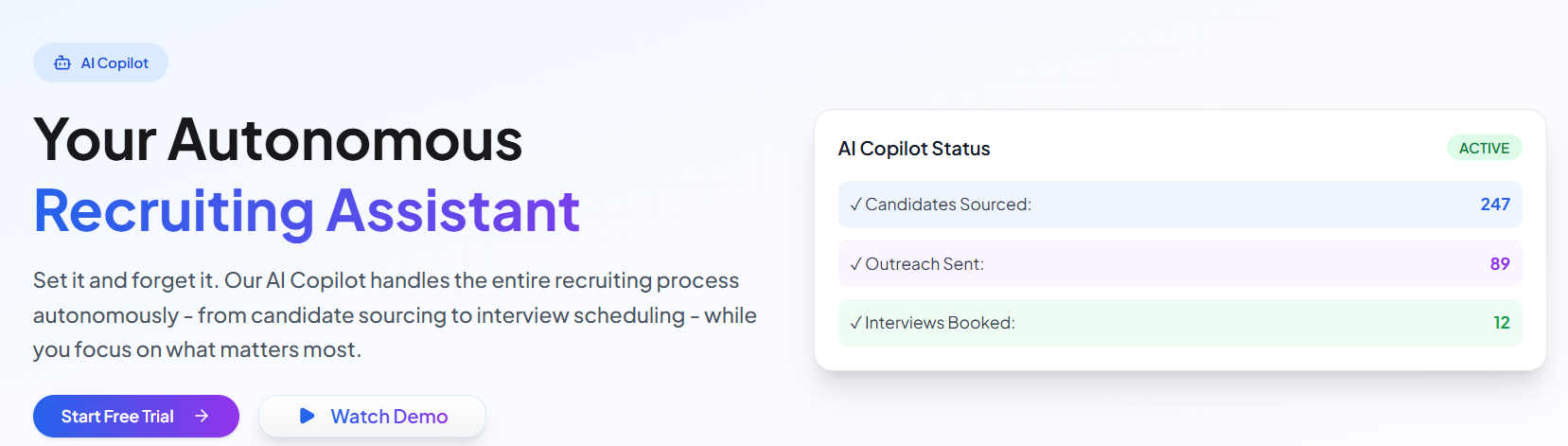
Leelu AI helps recruiters automate candidate matching and hiring workflows end-to-end.
Instead of manually switching between sourcing tools, ATS systems, spreadsheets, and outreach platforms, recruiters can manage the entire process from a single system.
With AI-powered matching capabilities, Leelu can:
- Scan 500M+ candidate profiles across platforms
- Parse and rank resumes automatically
- Identify top-fit candidates using AI scoring
- Automate outreach and follow-ups
- Schedule interviews with smart automation
- Sync workflows directly with ATS systems
This helps recruiting teams reduce manual work while improving shortlist quality and hiring speed.
The Future of AI Candidate Matching in Recruitment
AI recruiting technology is evolving rapidly.
Future AI hiring systems will likely become even better at understanding:
- Skill adjacencies
- Career potential
- Soft skills
- Candidate intent
- Internal mobility opportunities
At the same time, companies will continue focusing on ethical AI practices, transparency, and bias reduction.
Recruiters who learn how to combine AI efficiency with strong human decision-making will have a significant advantage in modern hiring.
Conclusion
Understanding how AI improves candidate matching in recruiting is becoming essential for modern hiring teams.
Traditional recruiting methods struggle to keep up with hiring volume, speed expectations, and talent competition.
AI helps solve these challenges by improving:
- Candidate discovery
- Resume screening
- Match accuracy
- Hiring efficiency
- Recruiter productivity
The goal is not to replace recruiters.
It is to help recruiters make faster, smarter, and more consistent hiring decisions.
As AI recruiting technology continues evolving, companies that adopt intelligent candidate matching systems early will likely build stronger hiring pipelines and improve overall talent acquisition outcomes.
Frequently Asked Questions
Can AI candidate matching work for niche or specialized roles?
Yes, modern AI recruiting systems can match candidates for niche roles by analyzing related skills, certifications, industry experience, and transferable capabilities instead of relying only on exact job titles.
This is especially useful for industries like cybersecurity, healthcare, SaaS, and engineering where skill overlap matters more than keywords.
Does AI candidate matching only work for large companies?
No, even small and mid-sized companies use AI recruiting tools to improve hiring efficiency.
AI becomes particularly valuable for lean recruiting teams that need to screen large application volumes without expanding recruiter headcount.
How does AI handle passive candidates in recruiting?
AI recruiting platforms can identify and engage passive candidates by analyzing online profiles, career signals, activity patterns, and previous engagement behavior.
This helps recruiters reach qualified candidates who are not actively applying for jobs.
Can AI candidate matching help reduce employee turnover?
Yes, some AI systems analyze hiring and retention patterns to identify candidates who are more likely to stay longer in a role.
Factors like career stability, role alignment, and work history patterns can help improve long-term hiring outcomes.
Is AI candidate matching useful for high-volume hiring?
AI is highly effective for high-volume recruiting because it can screen thousands of applications quickly and consistently.
Industries like BPO, retail, logistics, healthcare, and staffing often use AI to reduce screening time and accelerate hiring cycles.
How accurate are AI candidate matching systems?
The accuracy of AI matching depends on the quality of hiring data, job descriptions, and training models used by the platform.
Well-trained AI systems can significantly improve shortlist relevance, but human recruiter oversight is still important for final hiring decisions.
Can AI candidate matching integrate with ATS platforms?
Most modern AI recruiting platforms integrate with Applicant Tracking Systems (ATS) like Greenhouse, Lever, and Workday.
This allows recruiters to automate sourcing, screening, ranking, and candidate workflow management without changing existing hiring processes.
Does AI replace recruiters in the hiring process?
No, AI is designed to assist recruiters, not replace them.
AI handles repetitive tasks like resume screening and candidate ranking, while recruiters focus on interviews, relationship building, and final hiring decisions.