How AI Recruitment Chatbots Help Recruiters Hire Faster
You can have hundreds of candidates interested in a role and still struggle to move even a few of them to interviews.
The problem is not always a lack of candidates. It is often the time between candidate interest, screening, follow-ups, and interview scheduling.
A recruiter may spend hours answering the same questions, reviewing basic qualifications, chasing candidates for availability, and coordinating calendars.
That is where AI recruitment chatbots can make a practical difference.
Instead of making candidates wait for a recruiter to respond, an AI chatbot for recruitment can handle conversations instantly, collect relevant information, ask screening questions, and move qualified candidates toward the next step.
In this guide, you'll learn:
- What AI recruitment chatbots actually do
- Where they remove delays from the hiring process
- How they help recruiters screen candidates faster
- How automated scheduling reduces recruiter workload
- How chatbots improve candidate responsiveness
- Where chatbots can fall short
- How to connect conversational AI with an end-to-end recruiting workflow
What Is an AI Recruitment Chatbot?
An AI recruitment chatbot is a conversational AI system that interacts with candidates during different stages of the hiring process.
Instead of forcing every candidate interaction through email, forms, or recruiter calls, the chatbot gives candidates a conversational way to get information and complete simple recruiting tasks.
Depending on the system, it can:
- Answer questions about open positions
- Collect candidate information
- Ask pre-screening questions
- Check qualifications against role requirements
- Collect resumes or application details
- Recommend relevant roles
- Schedule interviews
- Send reminders and follow-ups
- Provide application updates
- Re-engage candidates who stop responding
Modern recruiting chatbots are therefore moving beyond the traditional “career site assistant.”
The stronger platforms can actually take recruiting actions instead of simply responding to questions. Current industry coverage increasingly describes screening, matching, in-chat applications, scheduling, ATS synchronization, and automated re-engagement as core capabilities.
That difference matters because conversation itself is not the goal. Faster movement through the hiring funnel is.
Why Recruiters Need More Than Faster Candidate Replies
A chatbot can respond to a candidate in seconds, but that alone does not necessarily shorten your hiring cycle.
The bigger opportunity is removing the small delays that accumulate between each recruiting stage.
Think about a typical candidate journey.
A candidate applies.
The recruiter reviews the application.
Someone sends a screening email.
The candidate responds two days later.
The recruiter asks another question.
The candidate responds again.
Someone checks calendars.
An interview is finally scheduled.
None of these steps looks particularly difficult.
Together, however, they can turn a simple application into a week-long process.
AI recruitment chatbots help by compressing these handoffs into a continuous conversation.
The candidate can move from interest → screening → qualification → scheduling without waiting for a recruiter to manually trigger every step.
That is where the real time savings start to appear.
Suggested Reading:
A Practical Guide to Project Management RecruitmentHow AI Recruitment Chatbots Help Recruiters Hire Faster
1. AI Chatbots Speed Up Initial Candidate Screening
AI recruitment chatbots speed up initial screening by asking candidates role-specific questions and collecting their answers before a recruiter gets involved.
Resume screening can become one of the biggest bottlenecks when a job attracts a large number of applications. A recruiter cannot have a meaningful conversation with every applicant.
Instead of manually emailing every candidate with the same questions, a chatbot can start the screening conversation as soon as the candidate engages.
For a customer support role, the chatbot might ask about:
- Relevant experience
- Shift availability
- Location
- Language skills
- Notice period
- Salary expectations
For a technical position, the questions can focus on certifications, tools, years of experience, or specific technical requirements.
The important part is that the conversation is tied to the role.
A simplified workflow could look like this:
Job requirement: 3+ years of Python experience↓Chatbot: “How many years of professional Python experience do you have?”↓Candidate: “4 years”↓Chatbot: Continues with the next relevant question↓Recruiter: Reviews the completed screening information
Instead of spending time collecting the same basic information from every applicant, recruiters receive structured information they can use for the next decision.
Indeed reported that applications per job in the U.S. doubled between 2022 and 2025 while the number of recruiters declined by 56%. When application volume grows faster than recruiter capacity, automating the first layer of qualification can become particularly useful.
Screening becomes a conversation instead of another form
A long application form can create friction before a recruiter even gets useful information.
Conversational screening changes that interaction.
Instead of presenting every question at once, the chatbot can ask one question, interpret the response, and continue based on the candidate's answer.
For example:
Chatbot: “Do you currently hold an active RN license?”
Candidate: “Yes.”
Chatbot: “How many years have you worked in an ICU setting?”
Candidate: “Four years.”
Chatbot: “Are you available for night shifts?”
The recruiter still makes the important hiring decisions. The AI handles the repetitive information-gathering layer.
That can shorten the time between application → initial qualification.
2. Instant Answers Prevent Candidate Delays
Candidates often have questions before they are willing to complete an application or screening process.
They may want to know:
- Is the position remote?
- What are the working hours?
- Where is the role located?
- What experience is required?
- What happens after I apply?
- When can I expect an interview?
- Can I apply for another position?
If every question requires a recruiter response, the recruiter becomes the communication bottleneck.
An AI chatbot for recruitment can answer approved questions immediately.
For example:
Candidate: “Is this role fully remote?”
Chatbot: “Yes. This position is remote within the U.S.”
Candidate: “How much experience is required?”
Chatbot: “The role requires at least three years of experience in…”
Candidate: “Can I apply?”
Chatbot: Starts the application or screening process.
The candidate moves forward while the recruiter continues working on other tasks.
This is especially useful outside normal working hours. A candidate who applies at 9 PM does not necessarily need to wait until the next morning just to get an answer to a basic question.
So the speed improvement comes from removing the question → recruiter → answer → next action delay.
3. Automated Scheduling Gets Qualified Candidates to Interviews Faster
Screening is only useful if qualified candidates can move forward quickly.
This is where automated interview scheduling removes another major delay.
Without automation, the process often looks like this:
Recruiter: “What time works for you?”
Candidate: “I'm available Tuesday afternoon.”
Recruiter: “How about 3 PM?”
Candidate: “I have another meeting then.”
Recruiter: “What about Wednesday?”
And the conversation continues.
An AI chatbot can connect screening with calendar availability.
Once a candidate meets the required criteria, the chatbot can present available interview slots and allow the candidate to select one.
The workflow becomes:
Screening completed → candidate qualifies → available slots displayed → candidate selects time → interview confirmed
Instead of requiring several emails or messages, scheduling can happen during the same candidate interaction.
Some recruiting chatbot platforms report that qualified candidates can self-schedule interviews within 24 hours. The exact result depends on the platform, workflow, and calendar setup, but the underlying mechanism is straightforward: fewer scheduling handoffs mean less waiting between qualification and interview.
That matters because a qualified candidate sitting in a recruiter's inbox is not yet moving through the hiring process.
4. 24/7 Conversations Keep Candidates Moving
Recruiting does not stop when the recruiter's workday ends.
Candidates may apply in the evening, respond during lunch, or become interested in a role over the weekend.
If the next step depends entirely on a recruiter being online, the candidate may have to wait hours before anything happens.
An AI recruitment chatbot can keep basic conversations moving around the clock.
It can:
- Answer common questions
- Collect candidate information
- Start screening
- Remind candidates about incomplete steps
- Provide information about the next stage
- Direct qualified candidates toward scheduling
Imagine a candidate starts an application at 10:30 PM.
Without automation:
Candidate applies → waits until recruiter is available → recruiter responds → candidate continues
With conversational automation:
Candidate applies → chatbot responds → candidate answers questions → screening continues
The recruiter can review the information later without requiring the entire process to stop overnight.
This creates an important shift in recruiting.
Instead of asking, “How quickly can my recruiter respond?”
you start asking:
“Which parts of this process actually need a recruiter?”
That distinction can help teams reserve recruiter time for decisions and conversations that require human involvement.
5. Automated Follow-Ups Reduce Candidate Drop-Off
Not every candidate disappears because they lost interest.
Sometimes the recruiting process simply loses momentum.
A recruiter sends a screening request.
The candidate gets busy.
Nobody follows up.
The application quietly becomes inactive.
AI can reduce this gap by automatically following up when a candidate has not completed the next step.
For example:
Candidate starts screening → leaves halfway through → chatbot sends reminder → candidate returns → screening continues
Or:
Candidate qualifies → does not select an interview slot → chatbot sends available options again → candidate schedules
The follow-up can also be triggered by the candidate's stage rather than sending the same generic message to everyone.
This is important because manual follow-up often competes with higher-priority recruiter work.
An automated system can handle the reminder while allowing recruiters to intervene when a candidate has a specific question or needs human attention.
The result is a shorter gap between candidate action → next recruiting action.
Suggested Reading:
10 Best Recruiting Platforms for Staffing Agencies to Scale Hiring6. Less Administrative Work Gives Recruiters More Time to Hire
The time saved by a chatbot does not come from one task.
It comes from removing many small administrative tasks from a recruiter's day.
Without automation, a recruiter may need to:
- Answer repetitive job questions
- Send screening questions
- Collect candidate information
- Follow up with incomplete applications
- Ask for interview availability
- Coordinate calendars
- Send reminders
- Update basic candidate information
With a recruitment chatbot handling appropriate parts of these tasks, recruiters can spend more time on work that requires human judgment.
That includes:
- Understanding candidate motivations
- Advising hiring managers
- Conducting meaningful interviews
- Building candidate relationships
- Handling complex situations
- Evaluating nuanced qualifications
- Closing strong candidates
So the productivity gain is not simply “AI does more work.”
It is:
AI handles repetitive steps → recruiters have fewer administrative interruptions → recruiters spend more time evaluating and engaging candidates → qualified candidates can move through the process faster.
7. Faster Communication Can Reduce Candidate Drop-Off
Speed also affects the candidate's experience.
Imagine two candidates applying for the same job.
Candidate A
Applies → receives an immediate response → completes screening → gets interview options → selects a time.
Candidate B
Applies → waits for a response → receives screening questions later → waits again → exchanges several messages about scheduling.
Even if both candidates eventually reach an interview, Candidate A experiences a much shorter and more predictable process.
A chatbot can help reduce unnecessary waiting by keeping candidates informed about what happens next.
For example:
“Your screening is complete. The next step is a 30-minute interview. Please choose a time below.”
That is more useful than leaving the candidate wondering whether someone received the application.
Phenom's 2025 analysis of Fortune 500 candidate journeys found that 83% of companies did not have a career-site chatbot that provided job recommendations.
That suggests there is still considerable room for employers to improve how candidates discover and navigate opportunities.
The goal should not be to automate every candidate interaction.
It is to make the interactions that can be automated faster, clearer, and easier to complete.
8. Connecting the Chatbot to the Recruiting Workflow Removes More Delays
This is where the biggest limitation of standalone AI recruitment chatbots becomes clear.
Adding a chatbot to your careers page does not automatically create an automated hiring process.
You can have an excellent conversational experience while recruiters still manually search for candidates, review profiles, update the ATS, send outreach, and coordinate interviews.
The chatbot may speed up one part of the funnel while the rest remains slow.
A broader workflow can connect the candidate conversation with other recruiting stages:
Sourcing → Candidate profile → Screening → Matching → Outreach → Conversation → Scheduling → ATS → Hiring insights
For example, imagine a recruiter needs a product manager with SaaS experience.
A chatbot can help once the candidate starts interacting with the company.
But an end-to-end recruiting system can address the earlier stages too:
Find relevant candidates → screen profiles → match candidates to the role → initiate outreach → engage interested candidates → screen → schedule interviews
That creates fewer disconnected steps between finding a candidate and getting that candidate into an interview.
This is also the difference between a standalone recruitment chatbot and a broader AI recruiting copilot.
A chatbot primarily handles conversations.
A recruiting copilot can help orchestrate multiple parts of the hiring workflow.
How Leelu Helps Beyond the Recruitment Chatbot
If your biggest problem is candidate communication, a standalone AI recruitment chatbot may solve part of the problem.
But if the bottleneck starts before the candidate conversation, you need to look at the entire funnel.
Leelu.ai is positioned as an AI recruiting copilot that automates sourcing, profile screening, outreach, and interview scheduling across the hiring workflow. Its messaging describes access to 500M+ profiles across LinkedIn, Indeed, Monster, and ATS systems.
That means the workflow can start before a candidate ever talks to an AI chatbot.
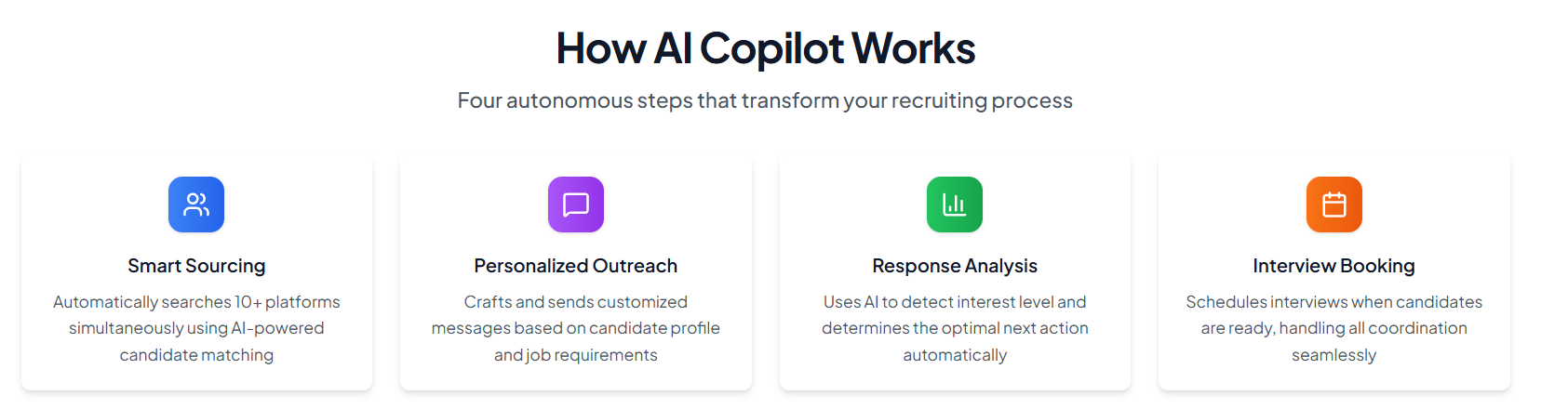
This broader approach matters when your hiring bottleneck is not simply “we receive too many questions.”
It may be that your recruiters are spending too much time across the entire funnel.
How to Measure Whether an AI Chatbot Is Actually Making Hiring Faster
Before implementing a chatbot, establish your current baseline.
Otherwise, it becomes difficult to tell whether automation is producing meaningful improvement.
Track metrics such as:
- Time from application to first response
- Time from application to screening
- Screening completion rate
- Time from qualification to interview
- Interview scheduling time
- Candidate response rate
- Candidate drop-off rate
- Recruiter hours spent on administrative work
- Time to shortlist
- Time to hire
Then compare those numbers after implementation.
You can also measure the funnel stage where the largest delay occurs.
For example, if sourcing is your bottleneck, a chatbot alone may not solve the problem.
If screening and scheduling are slowing you down, conversational automation may have a much larger impact.
This is why the best automation strategy starts with the bottleneck rather than the technology.
Final Thoughts
AI recruitment chatbots can help recruiters hire faster by removing delays from the candidate-facing side of the hiring process.
They can answer questions instantly, screen candidates, automate follow-ups, and move qualified applicants directly into interview scheduling.
But the biggest gains come when conversational AI is connected to the wider recruiting workflow.
If your recruiters are spending too much time answering repetitive questions, scheduling interviews, and following up with candidates, a chatbot can remove a meaningful amount of that work.
If your bottleneck stretches across sourcing, screening, outreach, scheduling, and ATS updates, an end-to-end AI recruiting copilot can address a much larger part of the process.
The goal is not to make recruitment less human.
It is to remove the repetitive work that keeps recruiters from spending more time with the people who matter most.
Frequently Asked Questions
How does an AI chatbot for recruitment help recruiters?
It reduces repetitive recruiter work by handling candidate conversations, basic screening, follow-ups, and interview scheduling automatically. This allows recruiters to spend more time on candidate evaluation, relationships, and hiring decisions.
Can AI recruitment chatbots screen candidates?
Yes. Modern recruiting chatbots can ask predefined or role-specific screening questions and use candidate responses to determine whether they meet specified requirements. The recruiter can then review qualified candidates instead of manually conducting every initial screening.
Do recruitment chatbots replace recruiters?
No. Their primary value is automating repetitive workflow rather than replacing human judgment. Recruiters can remain responsible for interviews, complex candidate decisions, stakeholder communication, and final hiring decisions.
How quickly can an AI recruitment chatbot schedule interviews?
The exact time depends on the recruiting platform, calendar integration, and workflow. With automated scheduling, qualified candidates can select available slots directly rather than waiting for recruiter emails and calendar coordination.
What should you look for in an AI recruitment chatbot?
Look for role-specific screening, candidate matching, automated follow-ups, interview scheduling, ATS integration, reporting, human handoff capabilities, and clear controls over how AI makes or recommends decisions.