9 Recruitment Automation Tools That Save 70% Hiring Time
Hiring still takes longer than it should, even with so many modern tools available today.
You spend hours sourcing candidates, screening resumes, and coordinating interviews, only to see delays pile up across your hiring process.
And while you’re stuck in this cycle, top candidates move fast and accept offers elsewhere.
That’s exactly where recruitment automation starts to change how you hire.
In this guide, you’ll explore:
- What recruitment automation really means
- Key features that actually reduce hiring time
- 9 tools that can save up to 70% of your effort
- How to choose the right tool for your hiring needs
Benefits of Using Recruitment Automation Tools
Now that you understand why hiring feels slow, it’s easier to see where automation fits in.
Recruitment automation tools don’t just speed things up, they simplify your entire hiring process by removing constant manual effort.
Tasks that once took hours start happening in minutes, helping your team focus more on decisions than coordination.
At the same time, you connect with candidates faster, maintain consistent communication, and avoid losing top talent due to delays.
Let’s break down the key benefits that directly impact your hiring results.
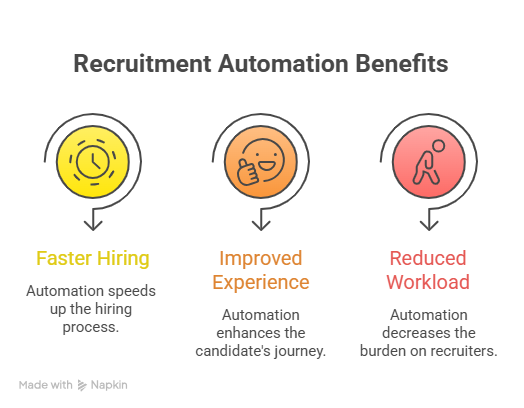
Faster Hiring Cycles
When you remove manual steps from your hiring process, everything starts moving faster.
Automation handles tasks like sourcing candidates, screening resumes, and scheduling interviews without delays or back-and-forth coordination. This reduces the time your team spends waiting between each stage.
As a result, your time-to-hire drops significantly because candidates move through the pipeline without friction. Instead of chasing updates, you can focus on making quicker decisions and closing roles before top candidates lose interest.
Improved Candidate Experience
A slow and inconsistent hiring process often frustrates candidates more than you realize.
With automation, candidates receive timely updates, quicker responses, and a smoother experience from application to interview. This keeps them engaged and reduces the chances of drop-offs during the process.
When communication feels seamless and professional, candidates are more likely to stay interested and view your company positively. Over time, this directly improves your employer brand and your ability to attract better talent.
Reduced Recruiter Workload
A large part of recruitment involves repetitive tasks that consume your team’s time.
Automation takes over activities like resume screening, follow-ups, and interview coordination, which removes a significant portion of manual effort. This means your recruiters are no longer stuck doing the same tasks repeatedly.
Instead, they can focus on high-impact work like evaluating candidates, building relationships, and making better hiring decisions. This not only improves efficiency but also makes the hiring process more strategic.
Key Features to Look for in Recruitment Automation Tools
Now that you understand the benefits, the next step is choosing the right tool.
Not all recruitment automation tools are built the same, and it’s easy to get distracted by features that don’t actually improve your hiring outcomes.
What really matters is how well a tool helps you move faster, reduce manual work, and hire better candidates.
Focus on capabilities that impact sourcing, engagement, and coordination, since that’s where most of your time goes.
Here are the key features you should prioritize.

AI Candidate Sourcing and Matching
Finding the right candidates is often the most time-consuming part of hiring.
AI-powered sourcing changes this by scanning large talent pools across platforms and identifying candidates that match your job requirements within seconds. Instead of manually searching through profiles, the tool brings relevant candidates directly to you.
What makes this powerful is the matching layer. AI doesn’t just find profiles, it ranks candidates based on how closely they fit your role. This helps you focus only on high-quality profiles and reduces the time spent filtering out irrelevant applications.
Automated Outreach and Candidate Engagement
Once you find candidates, the next challenge is reaching out and keeping them engaged.
Automation tools handle this by sending personalized messages at scale, without making your communication feel generic. You can set up outreach sequences, follow-ups, and reminders that run automatically in the background.
This ensures that no candidate is missed and every interaction happens on time. As a result, you see better response rates and spend far less time managing emails or tracking conversations manually.
Interview Scheduling Automation
Scheduling interviews is one of the most repetitive and frustrating parts of hiring.
Automation removes this friction by syncing calendars and allowing candidates to book available slots instantly. Instead of going back and forth over email, the process becomes quick and seamless.
This not only saves time but also keeps candidates engaged, as they can move to the next stage without delays. Over time, this significantly speeds up your overall hiring process.
9 Recruitment Automation Tools That Save 70% Hiring Time
Now that you know what features matter, the next step is choosing the right tools.
The right recruitment automation tool can reduce hiring time by streamlining sourcing, engagement, and scheduling.
Here are 9 tools that can help you save up to 70% of your hiring time and improve efficiency.
Leelu AI – End-to-End Recruitment Automation Platform
Hiring often slows down when you’re managing sourcing, outreach, and scheduling separately.
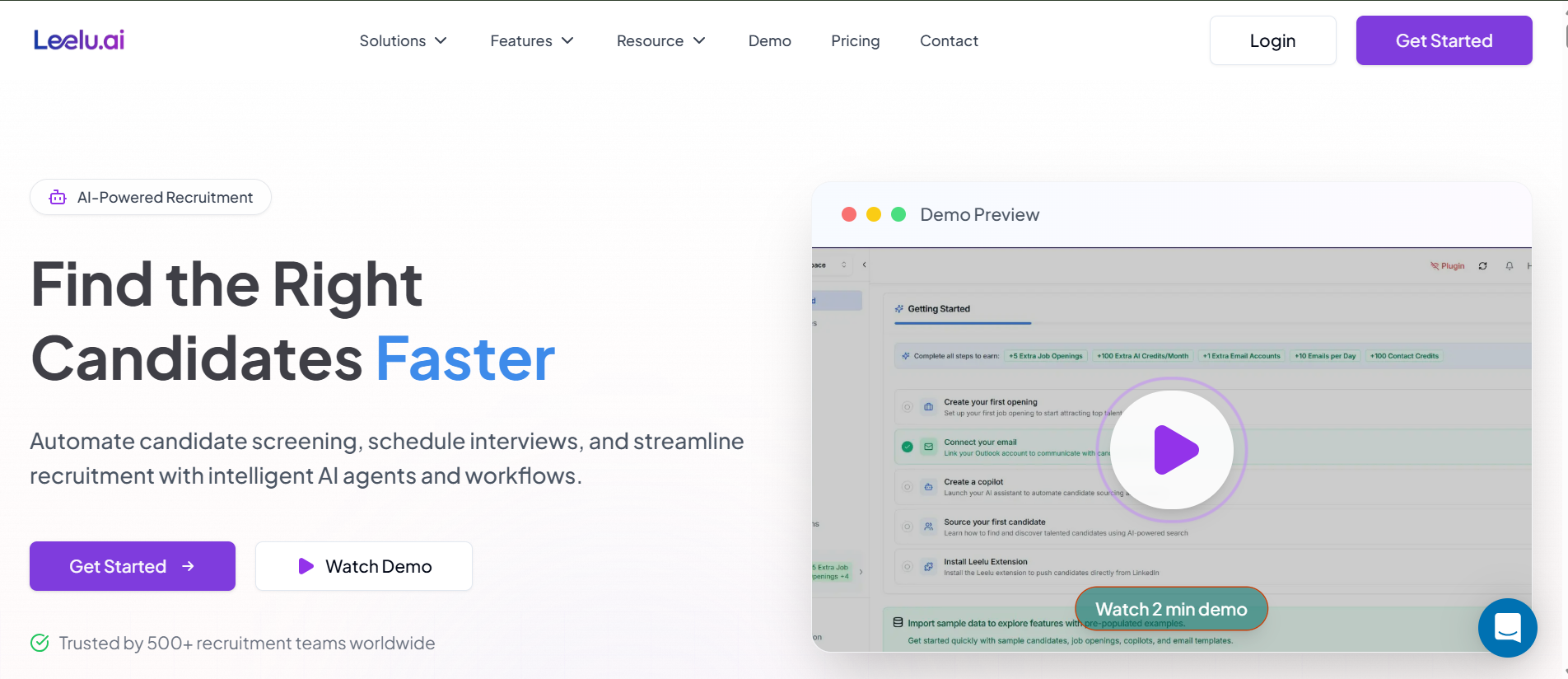
Leelu AI simplifies this by acting as an AI recruiting copilot that automates your entire hiring process from start to finish. Instead of switching between tools, you can manage everything in one place and move from job posting to interviews much faster.
It brings together sourcing, screening, outreach, and scheduling into a single workflow, helping you engage candidates across multiple platforms without manual effort. This not only speeds up your process but also improves consistency and candidate experience at every stage.
Key Features of Leelu AI
Leelu AI is built to automate high-effort tasks while keeping your hiring pipeline moving.
- Access 500M+ candidate profiles across LinkedIn, job boards, and ATS platforms
- Screen and rank 1000+ resumes in minutes using AI scoring
- Send 100–300 personalized outreaches per day across email and LinkedIn
- Automate 24/7 follow-ups with AI-driven responses
- Schedule interviews in less than 1 minute with calendar sync
- Integrate with 10+ platforms, including major ATS systems
These features help you reduce manual work while maintaining speed and quality across your hiring process.
Why Leelu AI Saves 70–85% Hiring Time
The real impact of Leelu AI comes from how it connects every step into one automated flow.
You no longer need to handle sourcing, screening, outreach, and coordination separately. Candidates are identified, engaged, and moved forward automatically, which reduces delays across your pipeline.
This leads to 70–85% reduction in hiring effort, faster shortlisting, and interview scheduling in minutes instead of hours. You can even move from job post to first interview in around 24 hours while improving response rates by 40–60%.
As a result, your team can scale hiring without increasing headcount or adding more tools, while still maintaining control over the entire process.
HireVue – AI Video Interviewing Platform
If screening candidates is slowing down your hiring process, this is where video interviewing tools make a difference.
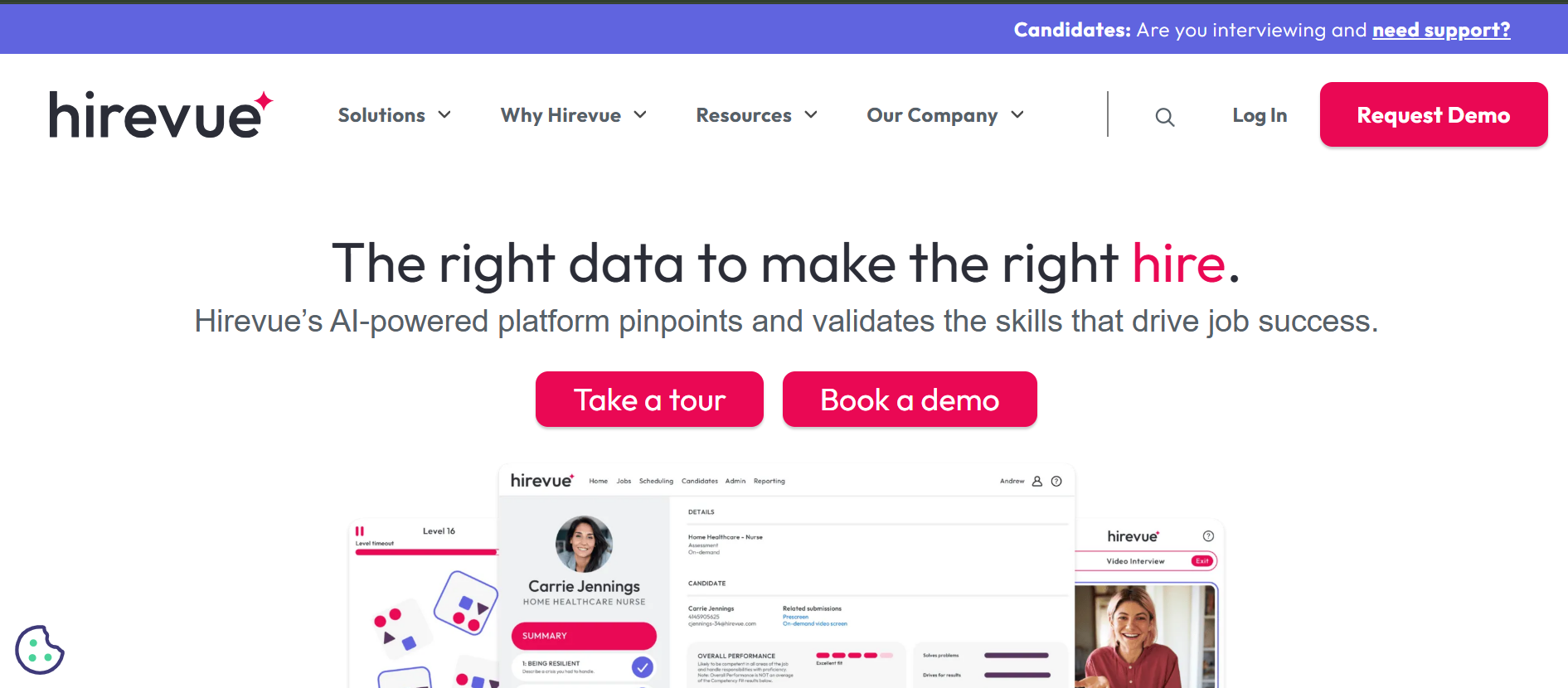
HireVue uses AI-powered video interviews and assessments to evaluate candidates at scale without requiring live rounds for every applicant. Instead of manually reviewing each profile, you can assess 100+ candidates in parallel through recorded responses.
The platform analyzes responses using AI to identify key skills and fit, helping you shortlist candidates up to 2–3x faster compared to manual screening.
Key Highlights:
- Conduct on-demand video interviews without scheduling conflicts
- Evaluate 100+ candidates simultaneously through recorded responses
- Use AI assessments to improve screening accuracy
- Reduce early-stage interview time by 50–70%
This significantly cuts down the time spent on initial evaluations and allows your team to focus only on the most relevant candidates, speeding up your overall hiring process.
Pymetrics – Behavioral Assessment Automation Tool
If you want to go beyond resumes and evaluate real candidate potential, this is where behavioral assessment tools help.
Pymetrics uses neuroscience-based games and AI to assess candidates based on cognitive and emotional traits rather than just experience. Instead of relying only on resumes, you can evaluate 100+ candidates simultaneously through short interactive assessments.
The platform analyzes behavioral data to match candidates with roles, helping improve hiring accuracy by 2–3x and reducing bias in decision-making.
Key Highlights:
- Assess soft skills and cognitive abilities through gamified tests
- Evaluate 100+ candidates at scale with automated assessments
- Improve match quality and reduce bias using AI insights
- Increase hiring accuracy by 30–50%
This helps you make more data-driven hiring decisions while reducing reliance on manual screening and subjective judgment.
XOR – AI Recruiting Chatbot for Candidate Engagement
If candidate communication is slowing down your hiring process, chat-based automation can make a big difference.
XOR uses an AI recruiting chatbot to handle candidate conversations across multiple channels, including career sites, SMS, and messaging platforms. Instead of manually responding to every query, you can engage 100s of candidates simultaneously through automated workflows.
The chatbot screens candidates, answers questions, and even schedules interviews, reducing manual effort significantly.
Key Highlights:
- Automate initial screening and FAQs through AI chat
- Engage 100–500 candidates at once across channels
- Schedule interviews automatically within chat workflows
- Reduce recruiter communication effort by 60–80%
This helps you maintain continuous engagement, speed up screening, and move candidates forward without delays.
Fetcher – Automated Candidate Sourcing Tool
If sourcing candidates is taking up most of your hiring time, automation can simplify the process.
Fetcher helps you discover and build talent pipelines faster by automating candidate sourcing and outreach. Instead of manually searching across platforms, the tool identifies and delivers 50–100 qualified candidates per role based on your requirements.
It continuously updates your pipeline, so you always have fresh candidates ready to engage.
Key Highlights:
- Automatically source 50–100 candidates per role
- Build and maintain active talent pipelines
- Combine sourcing with outreach in one workflow
- Reduce sourcing time by 60–70%
This allows you to focus less on searching and more on engaging the right candidates quickly.
Suggested Reading:
Top HR Metrics Every HR Professional Should TrackParadox (Olivia) – Conversational AI for Recruiting
If you want to improve both speed and candidate experience, conversational AI can transform how you interact with candidates.
Paradox, powered by its AI assistant Olivia, automates candidate conversations across career sites, SMS, and chat platforms. Instead of manual coordination, it can engage 100s of candidates simultaneously, answer queries, screen applicants, and schedule interviews in real time.
This creates a faster and more seamless hiring experience without delays.
Key Highlights:
- Engage 100–500 candidates at once through conversational AI
- Automate screening, FAQs, and interview scheduling
- Provide instant responses 24/7 to improve candidate experience
- Reduce time-to-schedule by 60–80%
This helps you move candidates forward quickly while delivering a smooth and responsive hiring journey.
Eightfold AI – Talent Intelligence Platform
If you want to make smarter hiring decisions at scale, predictive intelligence becomes essential.
Eightfold AI uses deep learning and data insights to match candidates with roles based on skills, experience, and potential. Instead of relying only on keywords, it analyzes large datasets to identify high-fit candidates and predict success in a role.
This helps you move beyond basic filtering and make more accurate hiring decisions.
Key Highlights:
- Analyze millions of candidate data points for better matching
- Use AI to improve match accuracy by 30–50%
- Identify high-potential candidates beyond resumes
- Reduce time spent on manual screening by 50–70%
This allows you to build stronger pipelines and make faster, data-driven hiring decisions.
Arya by Leoforce – AI Candidate Sourcing Platform
If finding candidates across multiple platforms is slowing you down, sourcing automation can simplify the process.
Arya by Leoforce uses AI to scan and source candidates from job boards, databases, and internal systems, helping you discover talent without manual searching. Instead of spending hours sourcing, you can identify 100+ relevant candidates per role within minutes.
This makes it easier to build strong pipelines without constant effort.
Key Highlights:
- Source candidates from multiple platforms in one search
- Discover 100+ qualified candidates per role quickly
- Use AI matching to improve candidate relevance
- Reduce manual sourcing effort by 60–70%
This helps you focus less on searching and more on engaging the right candidates faster.
TurboHire – End-to-End Recruitment Automation Software
If you want a single system to manage your entire hiring lifecycle, end-to-end platforms like TurboHire can help.
TurboHire combines sourcing, screening, engagement, and analytics into one platform, allowing you to manage every stage of hiring without switching tools. Instead of handling tasks separately, you can process 1000+ applications in minutes with AI-driven screening and matching.
This creates a more structured and efficient hiring workflow.
Key Highlights:
- Automate sourcing, screening, and engagement in one system
- Process 1000+ resumes quickly with AI-based screening
- Use analytics to track and optimize hiring performance
- Reduce overall hiring effort by 60–75%
This helps you streamline your hiring process while making faster and more data-driven decisions.
How to Choose the Right Recruitment Automation Tool for Your Needs
Not every tool delivers the same results, so focus on how well it solves your specific challenges.
The right tool should reduce delays, improve candidate quality, and fit naturally into your workflow.
This way, you avoid unnecessary complexity and invest in what actually improves your hiring outcomes.
Suggested Reading:
10 Candidate Sourcing ChannelsIdentify Bottlenecks in Your Hiring Process
Before choosing any tool, you need to understand where your hiring process slows down.
It could be sourcing candidates, screening resumes, or coordinating interviews. In many cases, these steps take up 60–70% of your hiring time due to manual effort and delays.
Once you identify these bottlenecks, it becomes easier to choose tools that directly address those gaps. This ensures you’re solving the real problem instead of adding more tools that don’t make an impact.
Match Features With Hiring Goals
After identifying bottlenecks, the next step is aligning features with your hiring goals.
If your goal is to hire faster, you should prioritize automation in sourcing and scheduling. If improving quality is the focus, then AI matching and screening become more important.
This approach helps you avoid tools with unnecessary features and focus only on what improves your outcomes. In most cases, the right feature set can improve efficiency by 50–70% without increasing complexity.
Consider Integration and Ease of Use
Even the best tool won’t help if it doesn’t fit into your existing workflow.
That’s why integrations and ease of use are critical when choosing a recruitment automation tool. Tools that connect with your ATS, job boards, and communication platforms reduce manual data entry and improve adoption across your team.
At the same time, a simple interface ensures your team can start using the tool quickly without long training cycles. This can improve productivity by 30–50% and help you see results faster.
Conclusion
Recruitment automation is becoming essential if you want to hire faster and smarter.
You explored key tools, features, and strategies that reduce hiring time.
With the right approach, you can streamline your process, improve candidate quality, and focus more on making better hiring decisions.
Frequently Asked Questions
What are recruitment automation tools?
They are tools that automate tasks like sourcing, screening, outreach, and scheduling, helping you reduce manual work and speed up hiring.
How much time can recruitment automation save?
Most tools can reduce hiring time by 50–70% by automating repetitive tasks and speeding up workflows.
Are recruitment automation tools suitable for small businesses?
Yes, they help small teams hire faster by reducing workload and improving efficiency without needing large recruiting teams.
Do these tools replace recruiters?
No, they support recruiters by handling repetitive tasks, allowing you to focus on decision-making and candidate relationships.
How do I choose the best recruitment automation tool?
Focus on your hiring needs, key features, integrations, and ease of use to choose a tool that fits your workflow.