Recruitment Campaigns Guide for Attracting the Right Candidates

Hiring the right candidate is rarely as simple as publishing a job description and waiting for applications.
For competitive roles, qualified candidates may never see your job posting. Some may not be actively looking for a new opportunity at all. Others may see dozens of similar job listings and ignore anything that feels generic.
This is where recruitment campaigns can make a difference.
A recruitment campaign gives your hiring team a structured way to identify the candidates you want to reach, choose the right channels, communicate the opportunity, and keep potential candidates engaged throughout the hiring process.
Instead of waiting for applications, recruiters can proactively build interest among people who are a strong fit for the role.
In this guide, we'll cover what recruitment campaigns are, how to plan one, how to create candidate-focused messaging, how to use multiple touchpoints, and how to measure campaign performance.
Why Recruitment Campaigns Matter for Modern Hiring
Recruiters often compete for the same pool of qualified candidates. Posting a job and waiting for applications can therefore limit your reach.
A well-planned recruitment campaign helps you take a more proactive approach.
Reach passive candidates
Some of the strongest candidates aren't actively searching for jobs. They may be employed, satisfied with their current position, or simply unaware of your company.
Direct recruitment campaigns give recruiters an opportunity to introduce relevant roles to these candidates.
Improve candidate targeting
Instead of reaching everyone who might click on a job advertisement, recruiters can define the specific candidate profile they want to attract.
This makes sourcing and outreach more focused.
Strengthen employer visibility
A recruitment campaign can communicate more than the responsibilities listed in a job description.
You can highlight:
- Career growth
- Company mission
- Team culture
- Interesting projects
- Learning opportunities
- Flexibility
- Benefits
- The impact of the role
This gives candidates more reasons to consider the opportunity.
Create a consistent candidate experience
When sourcing, outreach, follow-ups, screening, and scheduling are handled as part of one campaign, candidates are less likely to experience confusing or disconnected communication.
Make recruitment easier to measure
Campaigns allow recruiters to track where candidates came from, how they responded, and where candidates dropped out of the process.
That information can be used to improve future hiring campaigns.
How to Plan a Recruitment Campaign
A successful recruitment campaign starts before the first message is sent. The biggest mistake recruiters make is beginning with “Where can we find candidates?” before answering “Which candidates do we actually need?”
Your campaign should connect the hiring target, candidate profile, sourcing channels, messaging, and hiring timeline.
This matters because recruiting teams are already under pressure to fill roles efficiently. SHRM's 2026 benchmarking data found that the median time-to-fill for non-executive positions was 39 calendar days, while more than two-thirds of organizations reported difficulty hiring for open positions.
A recruitment campaign gives you a structured way to work backward from the hiring goal rather than simply collecting applications.
1. Define Your Hiring Goal
Start by clearly defining what the campaign needs to achieve.
For example:
Hire 10 senior software engineers within 60 days.
That's much more useful than:
We need more engineering candidates.
A measurable hiring goal should answer:
- How many people do you need to hire?
- Which roles are you hiring for?
- When do you need them to start?
- What experience level are you targeting?
- Which skills are essential?
- Where can candidates be located?
- How many qualified candidates do you need in the pipeline?
You should also work backward from your expected hiring conversion.
For example, suppose a company needs 10 hires and historically only 25% of interviewed candidates receive an offer, while 80% of accepted offers result in a completed hire.
The team may need approximately:
10 hires → 13 accepted offers → 40 interviews → 100 qualified candidates
That changes the recruitment campaign considerably. Instead of setting a vague target of “generate applications,” the recruiting team now knows it needs to build a pipeline of roughly 100 qualified candidates.
Your hiring goal should therefore define both the outcome and the volume of recruiting activity required to reach it.
2. Identify Your Ideal Candidates
Once the hiring goal is clear, create a specific candidate profile.
Don't simply copy the job description into your sourcing criteria. A job description describes the role; your candidate profile should explain what a strong candidate looks like and where you are likely to find them.
Start by separating requirements into must-have and nice-to-have qualifications.
For example, for a Senior Python Engineer:
Must-have
- 5+ years of software engineering experience
- Strong Python experience
- Experience building production applications
- Experience working with APIs and databases
- Strong communication skills
Nice-to-have
- Startup experience
- AWS or other cloud experience
- Experience with distributed systems
- Open-source contributions
- Experience leading a small engineering team
Then add targeting information such as:
- Previous job titles
- Relevant industries
- Company size
- Location
- Years of experience
- Career progression
- Technical skills
- Certifications
- Types of projects they've worked on
You should also consider why someone would want the role.
For example, a senior engineer may care more about technical ownership, architecture decisions, and career progression than generic statements about a “fast-paced work environment.”
Turn the job description into a candidate profile
This profile becomes the foundation for your sourcing, screening, and outreach strategy.
3. Estimate the Size of Your Candidate Pool
Before choosing recruitment channels, estimate how large your potential talent pool is.
This is particularly important for specialized roles.
If you need 10 candidates with a very specific combination of skills, targeting only a small geographic area may leave you with too few prospects.
For example:
A company needs 10 engineers with Python, AWS, and fintech experience in one city.
If the available talent pool is small, the recruiter may need to expand the campaign to:
- Other cities
- Remote candidates
- Adjacent industries
- Candidates with transferable skills
- People with slightly different job titles
- Passive candidates
You can also create different candidate tiers.
Tier 1: Candidates who meet every major requirement
Tier 2: Candidates who meet the core requirements but lack one preferred skill
Tier 3: Candidates with transferable experience who could become qualified with training
This prevents recruiters from making the candidate criteria unnecessarily restrictive.
4. Choose the Right Recruitment Channels
Not every candidate audience uses the same channels.
A recruitment campaign should therefore focus on the platforms where your ideal candidates are most likely to be found.
Common recruitment channels include:
Don't automatically distribute the same job advertisement across every channel.
Instead, match the channel to your candidate profile.
For example:
Hiring 100 customer support representatives
Prioritize job boards, employee referrals, social campaigns, and high-volume screening.
Hiring 5 cybersecurity engineers
Prioritize direct sourcing, specialist communities, professional networks, referrals, and personalized outreach.
Hiring a senior executive
Prioritize targeted search, referrals, executive networks, and highly personalized outreach.
The goal is to maximize relevant candidates.
5. Decide How Much of the Campaign Should Be Proactive
Your recruitment campaign should also determine how much effort goes toward inbound versus outbound recruiting.
Inbound recruitment means candidates discover and apply to your role through channels such as:
- Job boards
- Career pages
- Social media
- Employer branding campaigns
- Recruitment events
Outbound recruitment means recruiters proactively identify and contact potential candidates.
For example:
A company receives 500 applications for a software engineering position, but only 15% meet the core requirements.
Instead of relying entirely on those applications, the recruiter could add 200 carefully targeted passive candidates to the campaign.
This creates two pipelines:
Inbound → Applications → Screening → Interviews
Outbound → Sourced candidates → Outreach → Interested candidates → Screening → Interviews
Using both approaches can give recruiters more control over the size and quality of the candidate pipeline.
6. Set Campaign Targets for Each Stage
Once you know the hiring goal, turn it into measurable campaign targets.
For example:
These numbers are illustrative, not universal benchmarks. Your actual conversion rates will depend on the role, industry, location, compensation, employer brand, and candidate market.
The value of this framework is that it helps you identify where the campaign is breaking down.
For example:
- 500 prospects → 200 qualified: targeting may be working well.
- 150 contacted → 10 responses: messaging or targeting may need improvement.
- 45 positive responses → 35 qualified: sourcing quality is strong.
- 25 interviews → 13 offers: screening may be effective.
- 13 offers → 10 hires: offer competitiveness may be strong.
This turns recruitment into a measurable funnel rather than a collection of disconnected activities.
Recruitment Campaign Planning Example
Imagine a company wants to hire 20 customer success managers in 45 days.
Instead of immediately publishing the job, the team could plan the campaign like this:
Hiring goal: 20 hires in 45 days
Candidate profile: 2–5 years of B2B SaaS customer success experience
Primary channels: LinkedIn, employee referrals, job boards, existing talent database
Candidate target: 800 prospects
Qualified candidate target: 250
Outreach target: 500 candidates
Interview target: 60
Offer target: 25
Hiring target: 20
The team can then create different messaging for active applicants and passive candidates, automate appropriate follow-ups, and monitor conversion at every stage.
If the campaign produces plenty of candidates but very few interviews, the team knows to revisit its screening criteria or candidate quality. If candidates are interested but declining offers, compensation, role expectations, or the employer value proposition may need attention.
That is what makes a recruitment campaign different from simply posting a vacancy: every part of the process is planned around a measurable hiring outcome.
How to Create Recruitment Campaign Messaging That Candidates Notice
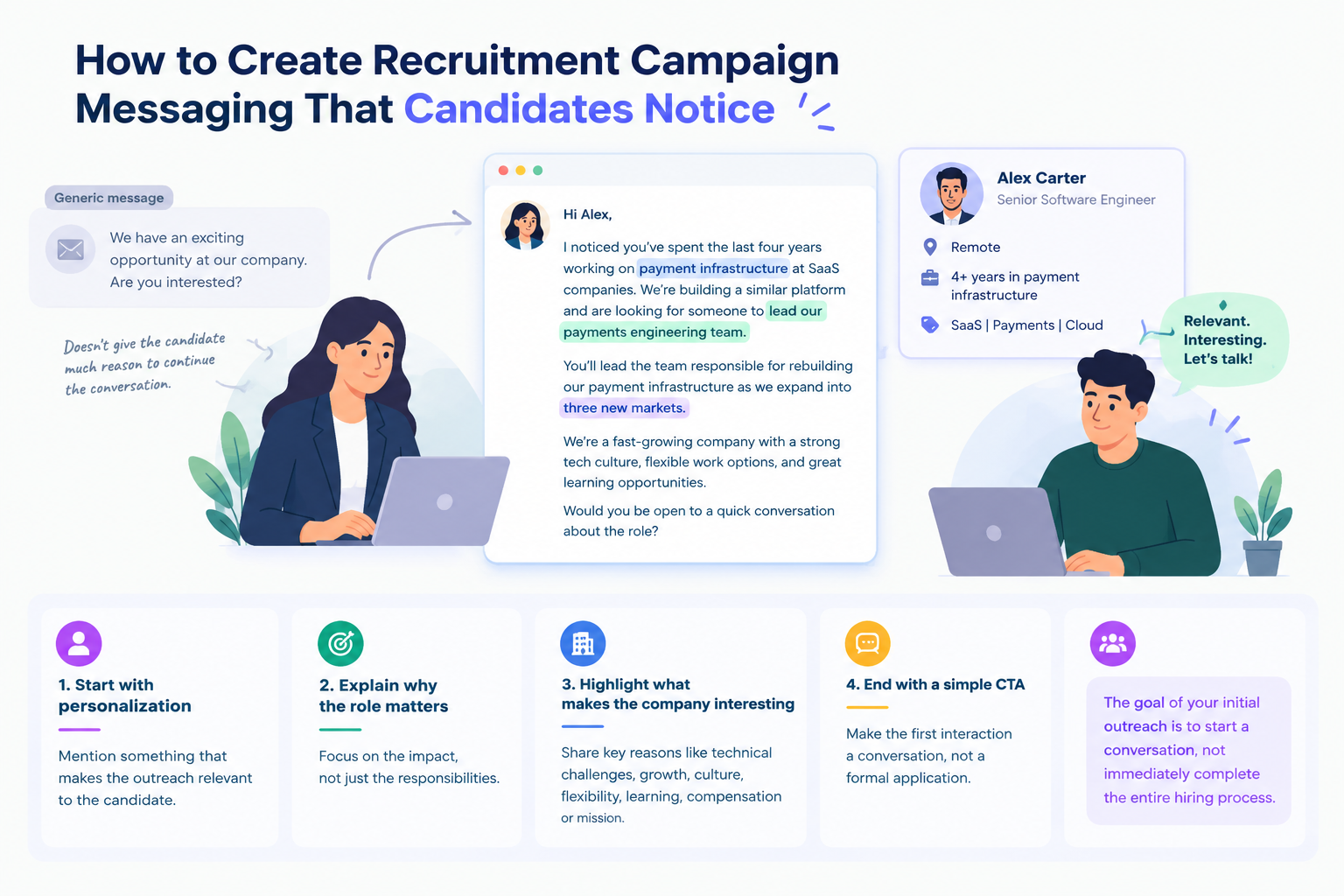
Finding the right candidates is only half the challenge.
You also need to give them a reason to respond.
A generic message such as:
We have an exciting opportunity at our company. Are you interested?
doesn't give the candidate much reason to continue the conversation.
Instead, recruitment messaging should connect the opportunity to something relevant to the candidate.
Start with personalization
Mention something that makes the outreach relevant.
For example:
I noticed you've spent the last four years working on payment infrastructure at SaaS companies.
We're building a similar platform and are looking for someone to lead our payments engineering team.
This is more relevant than sending the same message to hundreds of candidates.
Explain why the role matters
Candidates want to understand what they would actually be doing.
Instead of focusing entirely on responsibilities, explain the impact.
For example:
You'll lead the team responsible for rebuilding our payment infrastructure as we expand into three new markets.
That gives the candidate context about the opportunity.
Highlight what makes the company interesting
Depending on the role, this could include:
- Interesting technical challenges
- Career progression
- Company growth
- Team structure
- Mission
- Remote or hybrid flexibility
- Learning opportunities
- Compensation
The message doesn't need to include everything.
Choose the points most likely to matter to the candidate you're contacting.
End with a simple CTA
Don't make the first interaction feel like a formal application.
A simple question can work better:
Would you be open to a quick conversation about the role?
The objective of initial outreach is often to start a conversation, not immediately complete the entire hiring process.
Use Multiple Touchpoints to Keep Candidates Engaged
Recruitment campaigns shouldn't depend on one message.
Candidates may miss the first outreach, be busy when they receive it, or need more information before deciding whether to respond.
A structured sequence can help recruiters stay connected without overwhelming candidates.
Example recruitment campaign sequence
Day 1 — Initial outreach
Introduce the role and explain why the candidate appears relevant.
Day 4 — Follow-up
Briefly follow up and add another relevant detail about the opportunity.
Day 8 — Value-focused message
Share something useful, such as information about the team, project, career opportunity, or company.
Day 14 — Final follow-up
Send a short final message that gives the candidate an easy way to respond or decline.
The exact timing will vary by role and audience.
The key is to make every follow-up useful rather than simply sending:
Just checking in.
How to Measure the Success of Your Recruitment Campaign
A successful recruitment campaign is not just about generating applications.
You need to know whether you're reaching the right candidates and moving them through the hiring funnel.
Track these key metrics:
Candidate Reach
Measure how many relevant candidates your campaign reaches. Focus on candidate quality, not just reach.
Response Rate
Track how many candidates respond to your outreach. A low response rate can indicate issues with targeting, messaging, timing, or the opportunity itself.
Qualified Candidate Rate
Measure how many applicants or respondents meet the role requirements. A smaller pool of qualified candidates can be more valuable than hundreds of irrelevant applications.
Interview Conversion Rate
Track how many qualified candidates move to interviews. A low rate may indicate problems with screening criteria or candidate engagement.
Interview-to-Hire Conversion
Measure how many interviewed candidates become hires. This helps you understand whether your campaign is attracting candidates who are a strong fit for the role.
Time to Hire
Track the time from the first candidate interaction to an accepted offer. This can help identify delays in screening, interviews, or offer stages.
Cost per Hire
Calculate the total recruitment cost required to make a successful hire. Compare this across campaigns and channels to identify the most efficient sources.
Source of Hire
Compare channels based on the quality and number of hires they generate.
In this example, job boards generated the most candidates but the fewest hires. Referrals generated fewer candidates but produced the most hires.
The key is to evaluate the full recruitment funnel, not just application volume:
Reach → Responses → Qualified Candidates → Interviews → Offers → Hires
How AI Improves Recruitment Campaigns With Leelu
AI helps recruiting teams manage larger candidate pools while reducing repetitive manual work. Instead of handling every sourcing, outreach, and follow-up task manually, recruiters can use AI to streamline key parts of the campaign.
Tools such as Leelu AI can support recruitment campaigns by helping recruiters with:
- Candidate sourcing and matching based on job requirements
- Personalized candidate outreach at scale
- Automated follow-ups to keep candidates engaged
- Initial candidate conversations and responses
- Interview scheduling and coordination
AI should support recruiters, not replace their judgment. Recruiters still need to verify qualifications, assess candidate fit, conduct interviews, and make the final hiring decision.
Build Recruitment Campaigns That Attract the Right Candidates
A successful recruitment campaign isn't about contacting the largest possible number of candidates.
It's about creating a focused process that connects the right candidates with the right opportunity at the right time.
Start by defining your hiring goal and ideal candidate. Then choose the channels where those candidates are most likely to be found.
Create messaging that explains why the opportunity is relevant, use thoughtful follow-ups to maintain engagement, and measure the campaign from initial outreach through hiring.
As hiring volume increases, automation can help recruiters handle repetitive sourcing, screening, outreach, follow-ups, and scheduling tasks without sacrificing the candidate experience.
When recruitment becomes a measurable campaign rather than a collection of disconnected activities, your team has a clearer path to attracting qualified candidates and improving hiring outcomes.
Frequently Asked Questions
Should recruitment campaigns target active and passive candidates differently?
Yes. Active candidates may respond well to clear job details and an easy application process, while passive candidates usually need more context about why the opportunity is relevant to them.
Should every candidate receive the same recruitment campaign message?
No. The campaign can follow a consistent structure, but messaging should be adjusted based on factors such as experience, skills, industry background, and candidate motivation.
What is the difference between a recruitment campaign and a recruitment funnel?
A recruitment campaign is the overall strategy used to attract and engage candidates. A recruitment funnel shows how candidates progress through stages such as outreach, qualification, interviews, and hiring.
How many candidates should be included in a recruitment campaign?
There is no fixed number. The target should be based on the number of hires required, expected conversion rates, role difficulty, and the size of the available talent pool.