12 Types of Employment You Should Know for Hiring
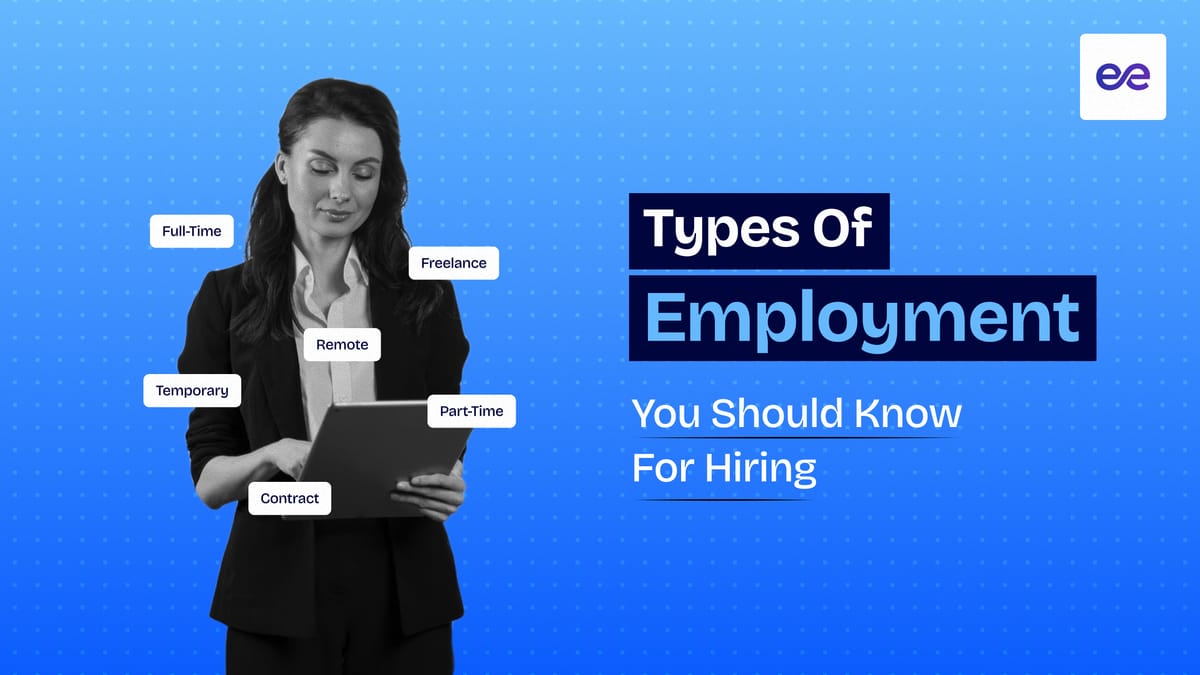
Hiring today is not just about filling a role — it’s about choosing the right employment type that actually fits your business needs.
Pick the wrong one, and you might end up overspending, struggling with compliance, or constantly rehiring for the same role.
So before you even start sourcing candidates, you need clarity on the types of employment available to you.
In this guide, you’ll understand:
- The most common types of employment
- When to use each employment type
- How different employment types affect your hiring strategy
What Are Types of Employment and Why Do They Matter?
Before you decide who to hire, you need to decide how to hire.
The employment type you choose defines everything — from how long someone works with you to how much control, flexibility, and responsibility you have as an employer.
It also directly impacts your hiring speed, costs, and team structure.
How Employment Type Impacts Hiring
- Determines your payroll and benefit obligations
- Affects how quickly you can scale your team
- Defines legal and compliance responsibilities
- Influences employee engagement and retention
When you understand different forms of employment, your hiring decisions become more intentional instead of reactive.
12 Different Types of Employment You Should Know
Now that you understand why this matters, let’s break down the most common different employment types and where each one fits best.
1. Full-Time Employment
Full-time employment is the most traditional and widely used employment type.
Employees work fixed hours and receive benefits like salary, insurance, and paid leave.
This works best when:
- You need long-term commitment
- The role is critical to business operations
- You want strong ownership and accountability
2. Part-Time Employment
Part-time employees work fewer hours compared to full-time staff.
They may not receive the same level of benefits, depending on company policies.
This is useful when:
- Workload is consistent but limited
- You want to control costs
- Flexibility is important
3. Temporary Employment
Temporary employment is designed for short-term needs.
These employees are hired for a specific period, often through agencies or contracts.
You can use this when:
- There’s a sudden spike in workload
- You need quick replacements
- Projects are time-bound
4. Contract Employment
Contract employment involves hiring professionals for a fixed duration with clearly defined deliverables.
Unlike full-time roles, these are outcome-focused rather than time-based.
This works best when:
- You need specialized expertise
- The role has a clear scope
- Long-term hiring is not required
5. Freelance Employment
Freelancers are independent professionals who work on a project or task basis.
They usually manage multiple clients at the same time.
You should consider this when:
- Tasks are short-term or creative
- You want maximum flexibility
- You don’t need ongoing involvement
6. Internship Employment
Internships are structured, short-term roles for students or recent graduates.
They are often used as a training and evaluation period.
This helps when:
- You want to build a talent pipeline
- You need support for entry-level tasks
- You plan to convert interns into full-time hires
7. Apprenticeship Employment
Apprenticeships focus on skill development through hands-on training.
They combine learning with real work experience over a longer period.
This is ideal when:
- Roles require technical or trade skills
- You want to train employees your way
- Long-term workforce development matters
8. Seasonal Employment
Seasonal employment is tied to specific times of the year.
Businesses hire workers during peak periods and reduce staff afterward.
This works well in:
- Retail during holidays
- Tourism during travel seasons
- Agriculture during harvest periods
9. Casual Employment
Casual employees work on an as-needed basis without guaranteed hours.
This offers flexibility but less predictability for both parties.
You can use this when:
- Work demand is unpredictable
- You need quick staffing adjustments
- Long-term commitment is not required
Suggested Reading:
Employment Verification Letter: How to Write + Free Templates & Samples10. Gig Employment
Gig employment involves short-term, flexible jobs, often facilitated by digital platforms.
Workers pick up tasks or “gigs” based on availability.
This is useful when:
- Tasks are highly flexible
- Speed is more important than continuity
- Work can be broken into smaller units
11. Remote Employment
Remote employment allows employees to work from anywhere instead of a physical office.
It has become one of the most popular various types of employment in recent years.
This is ideal when:
- You want access to global talent
- You want to reduce infrastructure costs
- Work does not require physical presence
12. Probationary Employment
Probationary employment is a trial period before confirming a permanent role.
It allows you to evaluate performance and cultural fit.
This helps when:
- You want to reduce hiring risk
- The role is critical
- You need real-world evaluation before commitment
How to Choose the Right Employment Type for Your Hiring Needs
Now that you’ve seen the different forms of employment, the real question is — which one should you choose?
The answer depends on your business goals, timelines, and resources.
Key Factors to Consider
- Is the role short-term or long-term?
- Do you need flexibility or stability?
- What is your hiring budget?
- How specialized are the skills required?
- What are the compliance requirements?
When you align the employment type with your hiring needs, you avoid unnecessary costs and hiring mistakes.
How Leelu Helps You Hire Across Different Employment Types
When you’re dealing with multiple employment types, speed and efficiency become critical.
You need a system that can handle everything without slowing down your hiring process.
Leelu acts as your AI recruiting copilot, helping you manage hiring end-to-end regardless of the employment type.
What You Can Do with Leelu
- Source candidates from 500M+ profiles across platforms
- Screen and match candidates based on job requirements
- Automate outreach and follow-ups at scale
- Schedule interviews instantly without coordination delays
This means you can go from job post to interview much faster, without increasing manual workload.
Conclusion
Choosing the right employment type is more than just an HR decision — it shapes how your team grows and performs.
When you understand the various types of employment, you can build a workforce that is flexible, efficient, and aligned with your business goals.
Instead of defaulting to one approach, you can mix different employment types to create a smarter hiring strategy.
Frequently Asked Questions
Can you combine multiple types of employment in one team?
Yes, and most growing companies already do this. You might have full-time employees handling core work, freelancers for creative tasks, and contract workers for specialized projects.
Which employment type is the most cost-effective?
There’s no one-size answer here. Freelancers and gig workers reduce long-term costs, but full-time employees often deliver better consistency and ownership.
Is contract employment better than full-time hiring?
It depends on your hiring goal. If you need flexibility and short-term expertise, contract employment works better.
If you’re building long-term capabilities, full-time employment is usually the smarter choice.
What are the risks of choosing the wrong employment type?
The wrong choice can lead to higher costs, compliance issues, and poor productivity. You might overpay for short-term work or struggle with retention in critical roles.
Is remote employment a separate employment type or a work model?
Remote employment is more of a work model than a standalone employment type. You can have remote full-time employees, remote freelancers, or remote contract workers.
It defines where people work, not how they are employed.