9 Welcome Email to New Employee That HR Teams Can Use
Starting a new job can feel exciting, but it can also bring uncertainty. Many new hires have questions about their first day, their team, and what to expect.
A well-written welcome email helps remove that uncertainty while making employees feel valued from the very beginning.
In fact, your welcome email is often one of the first meaningful interactions a new employee has with your company.
In this guide, you'll learn:
- Why welcome emails matter for employee experience
- What information every welcome email should include
- 9 welcome email templates you can use immediately
Why a Welcome Email Matters for New Employees
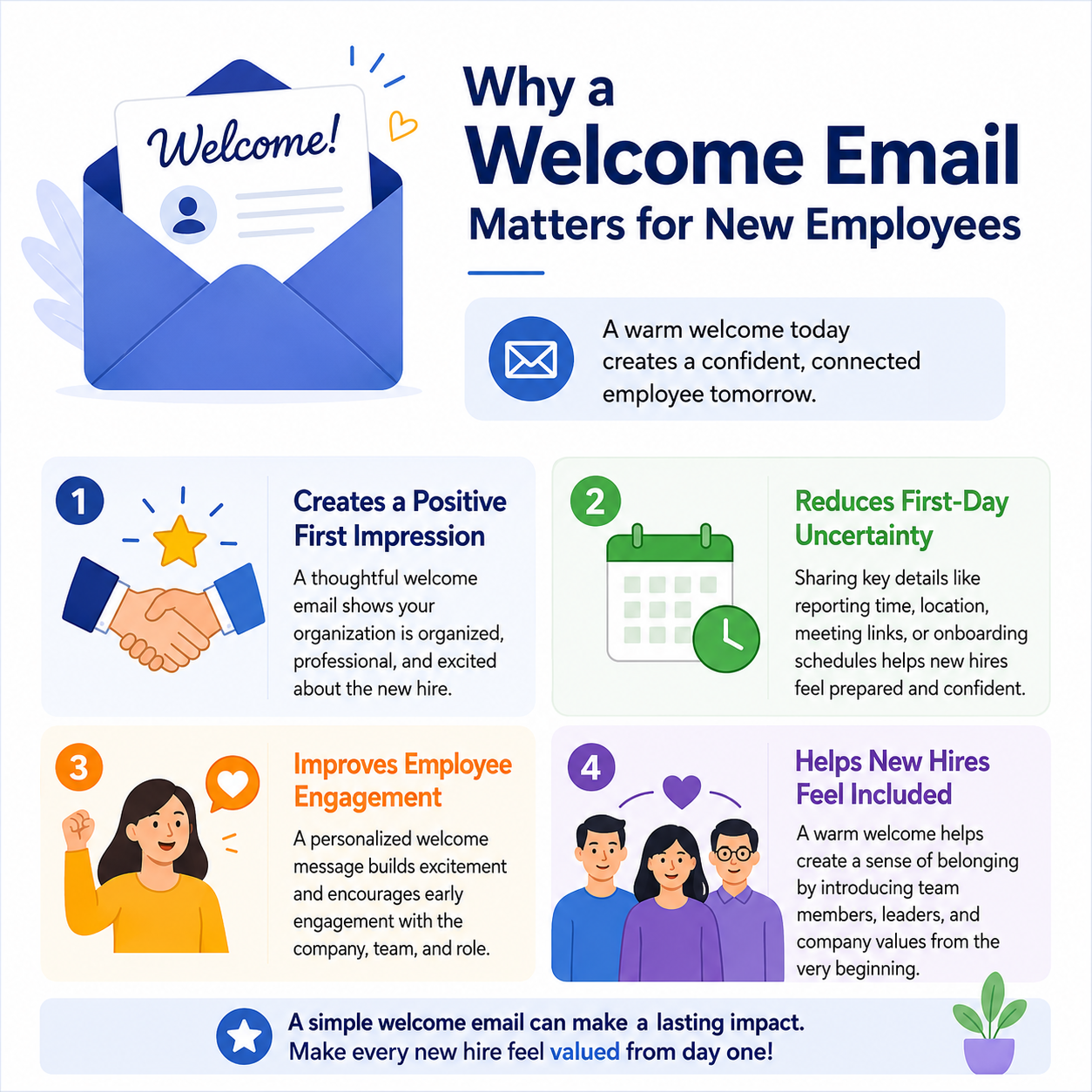
A welcome email may seem like a small step in the onboarding process, but it can have a lasting impact on a new employee's experience.
It helps set expectations, builds excitement, and creates a sense of connection before the first day even begins.
1. Creates a Positive First Impression
First impressions often shape how employees view an organization.
A thoughtful welcome email shows that your company is organized, professional, and genuinely excited about the new hire joining the team.
2. Reduces First-Day Uncertainty
Starting a new role usually comes with plenty of questions.
Sharing important details such as reporting time, location, meeting links, or onboarding schedules helps employees feel prepared and confident before their first day.
3. Improves Employee Engagement
Employees are more likely to feel motivated when they know their arrival is valued.
A personalized welcome message helps build enthusiasm and encourages early engagement with the company, team, and role.
4. Helps New Hires Feel Included
Joining a new workplace can feel overwhelming, especially when employees do not know anyone yet.
A warm welcome email helps create a sense of belonging from the start. Introducing team members, managers, or company values can make new hires feel like part of the organization even before they officially begin working.
What to Include in a Welcome Email to a New Employee
A welcome email should do more than simply greet a new hire.
It should provide the information employees need to feel prepared, confident, and excited about their first day. Including the right details helps create a smoother onboarding experience from the very beginning.
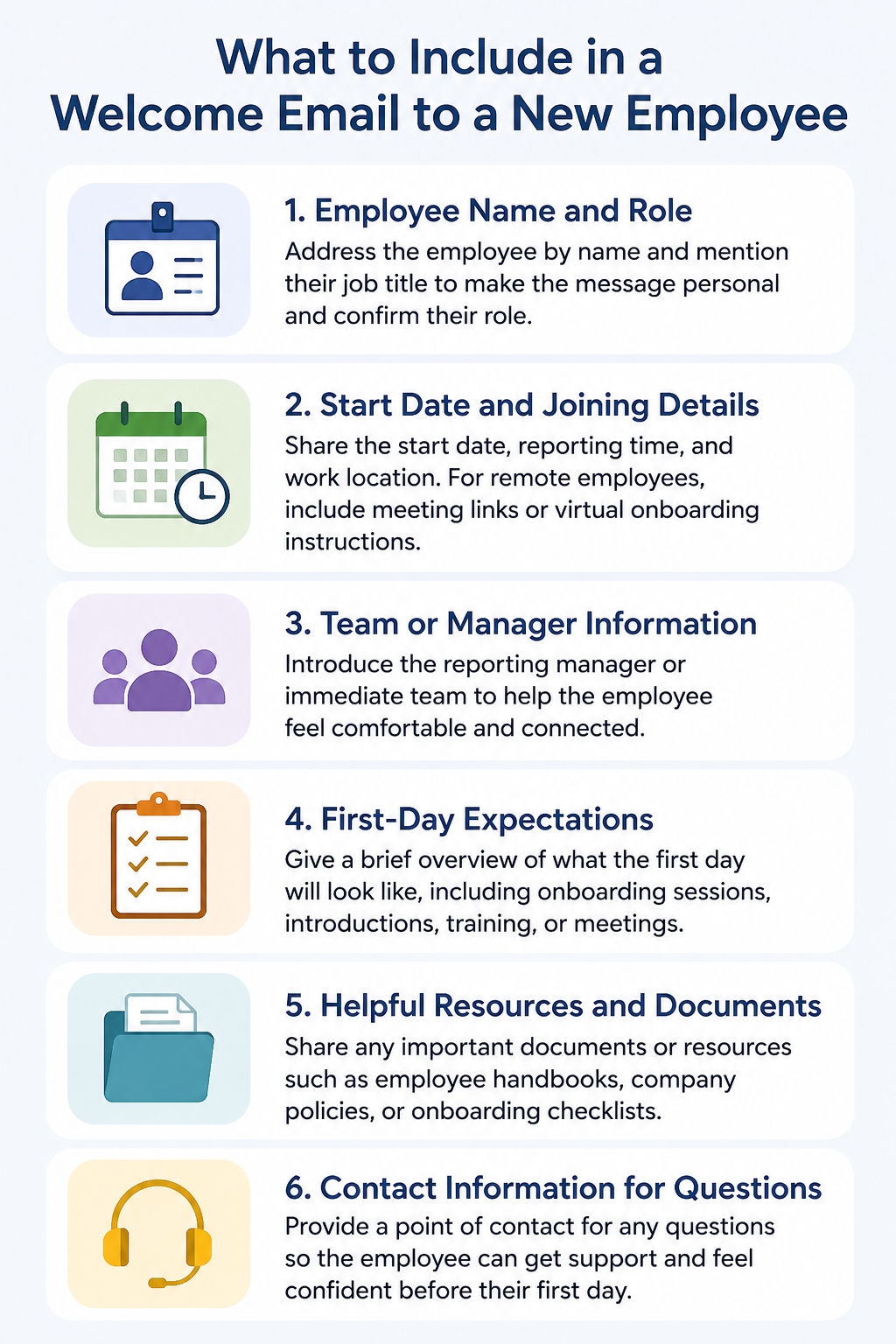
1. Employee Name and Role
Start by addressing the employee by name and mentioning their job title.
This personal touch makes the message feel genuine and confirms the position they are joining.
2. Start Date and Joining Details
Clearly mention the employee's start date, reporting time, and work location.
If the employee is joining remotely, include meeting links or virtual onboarding instructions.
3. Team or Manager Information
Introducing the reporting manager or immediate team helps employees know who they will be working with.
This can make the transition into a new workplace feel more comfortable.
4. First-Day Expectations
Give employees a brief overview of what their first day will look like.
This may include onboarding sessions, team introductions, training activities, or meetings.
5. Helpful Resources and Documents
Include any documents or resources employees may need before joining.
Examples can include employee handbooks, company policies, or onboarding checklists.
6. Contact Information for Questions
Always provide a point of contact for any questions.
Knowing who to reach out to helps employees resolve concerns quickly and reduces unnecessary stress before their first day.
Suggested Reading:
Employee Onboarding Checklist: Ultimate Guide for HR9 Welcome Email to New Employee
Now that you know what makes an effective welcome email, the next step is putting it into practice.
The good news is that you do not need to create every message from scratch. The following welcome email templates can help you communicate with new hires in different situations while maintaining a warm and professional tone.
1. Simple Welcome Email for New Employees
This template works well for most new hires and focuses on making them feel valued.
Subject: Welcome to [Company Name]
Hi [Employee Name],
Welcome to [Company Name]!
We are excited to have you join us as our new [Job Title]. Your skills and experience will be a valuable addition to our team.
Your start date is [Date], and we look forward to meeting you soon. If you have any questions before your first day, please feel free to reach out.
We are happy to have you on board.
Best Regards,[Sender Name]
2. Formal Welcome Email Before the First Day
A more professional option for corporate environments or senior positions.
Subject: Welcome to [Company Name]
Dear [Employee Name],
On behalf of everyone at [Company Name], I would like to formally welcome you to our organization.
We are pleased that you have accepted the position of [Job Title]. Your employment will begin on [Start Date], and you are expected to report at [Time].
Please find the required onboarding documents attached for your review before joining.
We look forward to your contributions and wish you great success in your new role.
Sincerely,[Sender Name]
3. Friendly Team Introduction Email
Sometimes the goal is not only to welcome a new hire but also to introduce them to the people they will work with every day.
Subject: Meet Your New Team
Hi [Employee Name],
We're excited to welcome you to the team!
You'll be working closely with several talented colleagues who are looking forward to meeting you and helping you settle into your new role.
Here's a quick introduction to your team:
[Team Member Name] – [Role]
[Team Member Name] – [Role]
[Team Member Name] – [Role]
Feel free to reach out and introduce yourself before your first day.
We can't wait to work with you.
Cheers,[Sender Name]
4. Remote Employee Welcome Email
Remote employees often need additional guidance before joining.
Providing clear instructions helps create a smooth onboarding experience from day one.
Subject: Welcome to Our Remote Team
Hi [Employee Name],
Welcome to [Company Name]!
As you prepare for your first day, we wanted to share a few important details.
Here is what you'll need before joining:
Your company laptop and equipment
Access credentials for company tools
Internet connection and workspace setup
Video meeting platform access
Your virtual onboarding session will take place on [Date] at [Time].
You can join using the following meeting link: [Link].
If you experience any technical issues or have questions before your start date, please contact us anytime.
We're excited to have you as part of our remote team and look forward to working together.
Best Regards,[Sender Name]
5. Hybrid Employee Welcome Email
Hybrid employees need clarity around both in-office and remote work arrangements.
A welcome email can help set expectations from the start and avoid confusion during the onboarding process.
Subject: Welcome to [Company Name]
Hi [Employee Name],
We're excited to welcome you to the team as our new [Job Title].
As a hybrid employee, you'll have the flexibility to work both remotely and from our office. Your manager will share your work schedule and team collaboration guidelines during onboarding.
Here are a few important details:
Start Date: [Date]
Reporting Time: [Time]
Office Location: [Address]
Remote Work Tools: [Tools]
We're looking forward to working with you and helping you settle into your new role.
Best Regards,[Sender Name]
6. Welcome Email for Executive or Leadership Hires
Leadership hires often require a more personalized and professional welcome message.
This email should communicate confidence, trust, and excitement about their future contributions.
Subject: Welcome to the Leadership Team
Dear [Employee Name],
It is our pleasure to welcome you to [Company Name] as our new [Position].
We are confident that your leadership experience and expertise will play an important role in helping us achieve our goals and drive future growth.
We look forward to collaborating with you and supporting your transition into the organization.
Please let us know if there is anything we can do to assist you before your start date.
Warm Regards,[Sender Name]
7. Internship Welcome Email
Interns are often entering a professional environment for the first time.
A friendly and encouraging email can help them feel comfortable and excited about the opportunity.
Subject: Welcome to Your Internship Program
Hi [Intern Name],
Congratulations and welcome to [Company Name]!
We're excited to have you join us as an intern and gain hands-on experience with our team.
During your internship, you'll have opportunities to learn, contribute to meaningful projects, and build valuable professional skills.
If you have any questions before your first day, don't hesitate to reach out.
We look forward to helping you make the most of this experience.
Best Wishes,[Sender Name]
8. Welcome Email with First-Day Instructions
Some organizations prefer to send a welcome email focused on practical onboarding details.
This helps employees arrive prepared and ready to begin work immediately.
Subject: Important Information for Your First Day
Hi [Employee Name],
We're excited to welcome you to [Company Name].
To help you prepare, please review the following first-day instructions:
Arrive by [Time]
Bring a valid photo ID
Complete attached onboarding forms
Report to [Manager/Department]
Attend the scheduled orientation session
If you have any questions before joining, please contact us at [Email Address].
We look forward to meeting you soon.
Best Regards,[Sender Name]
9. Welcome Email Focused on Company Culture
A culture-focused welcome email helps new employees understand the values and environment they are joining.
It creates a stronger emotional connection before their first day.
Subject: Welcome to the [Company Name] Family
Hi [Employee Name],
Welcome to [Company Name]!
We're excited to have you join a team that values collaboration, innovation, learning, and mutual respect.
At our company, we believe that great work happens when people feel supported, empowered, and connected.
As you begin your journey with us, you'll have opportunities to learn, grow, and make a meaningful impact alongside talented colleagues.
We're looking forward to getting to know you and helping you succeed.
See you soon!
Best Regards,[Sender Name]
Suggested Reading:
Modern Onboarding Process Steps for HR ProfessionalsCommon Mistakes to Avoid in Welcome Emails
A welcome email should make new employees feel informed, prepared, and excited about joining your organization.
However, even well-intentioned emails can miss the mark if they contain common onboarding mistakes. Avoiding these issues can help create a better first impression and a smoother employee experience.
1. Sending Generic Messages
Employees can quickly tell when an email feels copied and pasted.
Adding the employee's name, role, and a personalized welcome message makes the email feel more genuine and engaging.
2. Including Too Much Information
While it is important to share useful details, overwhelming employees with lengthy instructions or multiple attachments can create confusion.
Focus on the most important information and keep the message easy to read.
3. Forgetting Important Joining Details
Missing key information such as the start date, reporting time, office location, or meeting links can create unnecessary stress.
Always double-check that all essential joining details are included before sending the email.
4. Using Overly Formal Language
A welcome email should feel warm and approachable.
Using overly formal language can make the message sound distant and less personal. A friendly tone often helps new hires feel more comfortable.
5. Sending the Email Too Late
Timing matters just as much as the content.
Sending the welcome email several days before the employee's start date gives them enough time to prepare, ask questions, and arrive with confidence on their first day.
Conclusion
A well-crafted welcome email is one of the simplest ways to create a positive onboarding experience. It helps new employees feel informed, valued, and connected before they even start their first day.
By including essential details, maintaining a friendly tone, and personalizing your message, you can reduce uncertainty and build excitement around the new role.
Whether you're welcoming an intern, remote employee, or senior leader, the right welcome email sets the foundation for a successful employee journey and a stronger relationship with your organization.
Frequently Asked Questions
1. When Should a Welcome Email Be Sent?
A welcome email should ideally be sent immediately after offer acceptance or at least a few days before joining.
2. Who Should Send the Welcome Email?
The welcome email can be sent by HR, the hiring manager, or both, depending on company preferences.
3. How Long Should a Welcome Email Be?
A welcome email should be concise, clear, and informative, typically between 100 and 200 words in length.
4. Can Welcome Emails Be Automated?
Yes, welcome emails can be automated through HR software while still including personalized details for each employee.